PPC marketing is transforming digital advertising at a remarkable pace, and businesses in 2026 face higher stakes than ever to stay ahead. The landscape is filled with new technologies, data-driven tactics, and rapidly evolving consumer behaviours.
This guide will give you the latest PPC marketing strategies, tools, and actionable insights to help you achieve measurable results. Discover the fundamentals, campaign types, platform selection, step-by-step campaign creation, advanced optimisation, and future trends.
Ready to outperform your competition? Use these expert insights to power your next PPC marketing campaign and secure your place in the digital marketplace.
Understanding PPC Marketing in 2026
The landscape of ppc marketing is advancing rapidly, driven by new technologies, shifting consumer expectations, and the need for measurable business outcomes. In 2026, businesses must understand the foundations of ppc marketing to compete effectively in the digital space. This section explores what makes ppc marketing essential, unpacks its terminology, compares it to organic strategies, and highlights its unique benefits for growth.
What is PPC?
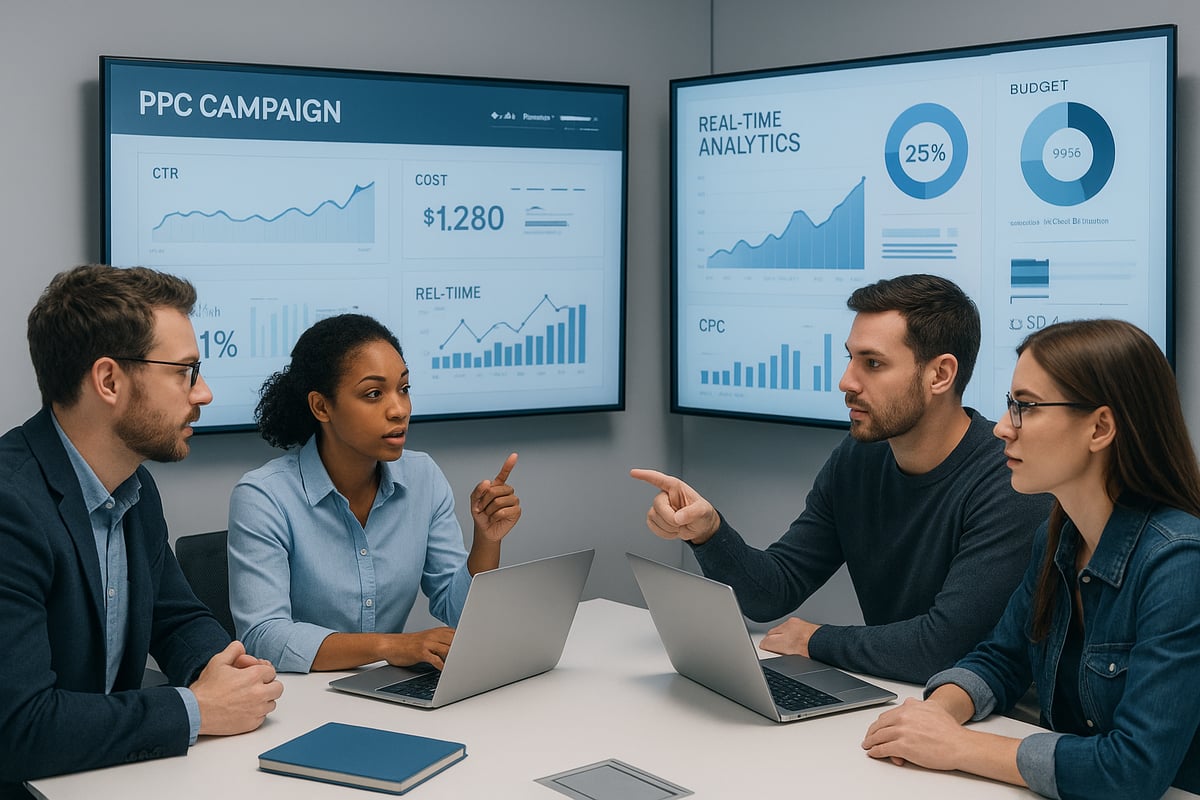
Pay-Per-Click (PPC) marketing is a model where advertisers pay each time a user clicks on their online ad. This approach allows brands to bid for ad placements on search engines, social media, and other digital platforms, ensuring immediate exposure to targeted audiences.
In the broader digital marketing ecosystem, ppc marketing complements organic strategies by delivering instant visibility and measurable traffic. Over recent years, PPC has evolved significantly, embracing automation and artificial intelligence to optimise bidding, targeting, and creative delivery. For example, Google Ads and social PPC campaigns now use smart algorithms to drive instant results and reach the right users at the right time.
To explore the fundamentals and best practices of ppc marketing, see the Pay-per-click advertising guide.
Key PPC Terminology and Concepts
Understanding core concepts is vital for effective ppc marketing. Here are essential terms:
| Term | Definition |
|---|---|
| CPC | Cost Per Click: what you pay per ad click |
| CPM | Cost Per Mille: price per 1,000 impressions |
| Ad Rank | Position score based on bid and ad quality |
| Quality Score | Rating of ad relevance and landing page experience |
| Bid | Maximum amount you’re willing to pay per click |
| Ad Groups | Sets of ads targeting related keywords |
| Landing Page | Destination page after ad click |
Each metric affects your campaign’s performance. For instance, a higher Quality Score can lower your costs and improve ad placement. The anatomy of a typical ad includes a headline, description, and display URL, all of which must align with your chosen keywords and user intent. The interplay between bidding strategy and ad quality determines how effectively your ppc marketing budget is spent.
PPC vs. Organic Marketing: Key Differences
When comparing ppc marketing to organic approaches, speed and control stand out. PPC offers immediate results, placing your ads in front of potential customers as soon as campaigns go live. Organic marketing, such as SEO, builds authority and long-term value but can take months to deliver significant results.
PPC marketing provides data that can inform your SEO efforts, and vice versa, supporting a holistic strategy. For example, a brand might use ppc marketing for product launches to generate buzz, while relying on organic content for sustained visibility. Data shows paid ads can appear instantly, while achieving top organic rankings often requires ongoing investment and patience.
Benefits of PPC in 2026
PPC marketing in 2026 delivers several powerful benefits:
- Instant reach and exposure on multiple platforms, from search engines to social media.
- Precision targeting using advanced segmentation, personalisation, and AI-driven audience insights.
- Enhanced ROI tracking with improved attribution models, allowing you to measure every pound spent.
- Flexibility and adaptability to respond quickly to algorithm changes and evolving consumer behaviours.
Common use cases for ppc marketing include lead generation, product launches, and increasing brand awareness. The impact is measurable: retargeting can increase conversion rates by up to 70% (Semrush). As part of a holistic digital strategy, ppc marketing ensures your brand remains agile, competitive, and ready for future trends.
Types of PPC Campaigns and Choosing the Right Model
Understanding the variety of campaign types is essential for success in ppc marketing. Each model offers unique advantages, targeting methods, and creative formats, enabling businesses to connect with audiences at different stages of the buying journey.
Search Campaigns
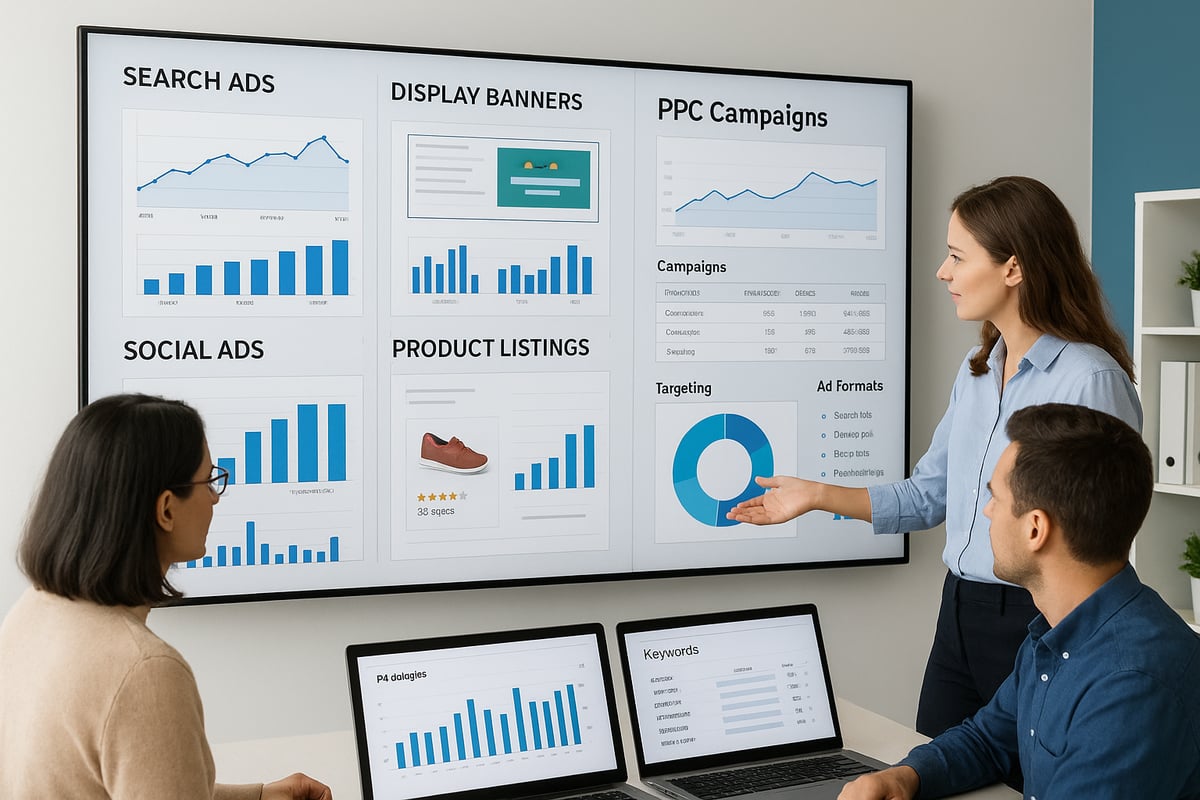
Search campaigns are the backbone of ppc marketing. These text-based ads appear on search engine results pages when users enter specific keywords. They capture high-intent audiences who are actively looking for solutions.
- Ads are triggered by targeted keywords.
- Ideal for driving immediate conversions.
- Example: A user searches “wedding dress sale” and sees a relevant ad at the top of Google.
Search campaigns are perfect for businesses aiming to reach customers ready to take action.
Display Campaigns
Display campaigns use visually engaging banners or image ads that appear across websites within ad networks. This campaign type is effective for raising brand awareness and supporting retargeting initiatives.
- Banners can include strong calls to action and compelling visuals.
- Excellent for introducing new products or services.
- Example: Eye-catching banner ads displayed on popular blogs or news sites.
For those wanting to learn more about crafting high-performing display ads, see Effective pay-per-click ads.
Social Media PPC
Social media ppc marketing allows advertisers to reach highly segmented audiences on platforms like Facebook, Instagram, LinkedIn, and TikTok. These campaigns offer advanced targeting based on demographics, interests, and behaviours.
- Sponsored content blends seamlessly into user feeds.
- Creative formats include carousels, stories, and video.
- Example: TikTok ad campaigns using AI-driven targeting to engage mobile users.
Social media PPC is ideal for building community engagement and driving website traffic.
Remarketing/Retargeting
Remarketing or retargeting campaigns reconnect with users who have previously visited your site or engaged with your brand. This approach significantly increases the likelihood of conversion by focusing on warm leads.
- Ads follow users across platforms and websites.
- Custom messaging encourages users to return and complete desired actions.
- Data shows retargeted users are up to 70% more likely to convert.
Incorporating remarketing into your ppc marketing strategy can help recover missed opportunities and boost ROI.
Video Ads
Video ads are a powerful format within ppc marketing, available on platforms like YouTube and social media channels. These ads capture attention through storytelling, visuals, and audio.
- Formats range from short pre-roll clips to longer branded content.
- Ideal for increasing brand recall and influencing purchase intent.
- Example: A YouTube pre-roll ad that tells a compelling brand story in 15 seconds.
Video ads can be particularly effective for brands looking to make a memorable impression.
Shopping Ads
Shopping ads are designed for e-commerce businesses. These product-based ads appear in carousel format on search engines, showing images, prices, and brand names.
- Users see key product details before clicking.
- Excellent for promoting special offers or seasonal sales.
- Example: Google Shopping ads highlighting a “20% off” promotion for trainers.
Shopping ads streamline the path from search to purchase, making them a vital part of ppc marketing for online retailers.
Choosing the Right Campaign Type
Selecting the right campaign model depends on your business objectives, target audience, budget, and product or service type. A successful ppc marketing strategy often blends multiple campaign types to cover the entire sales funnel.
Consider combining search, display, social, and remarketing to maximise reach and efficiency. Multi-channel campaigns ensure your brand stays visible and competitive in the digital landscape.
Top PPC Platforms for 2026
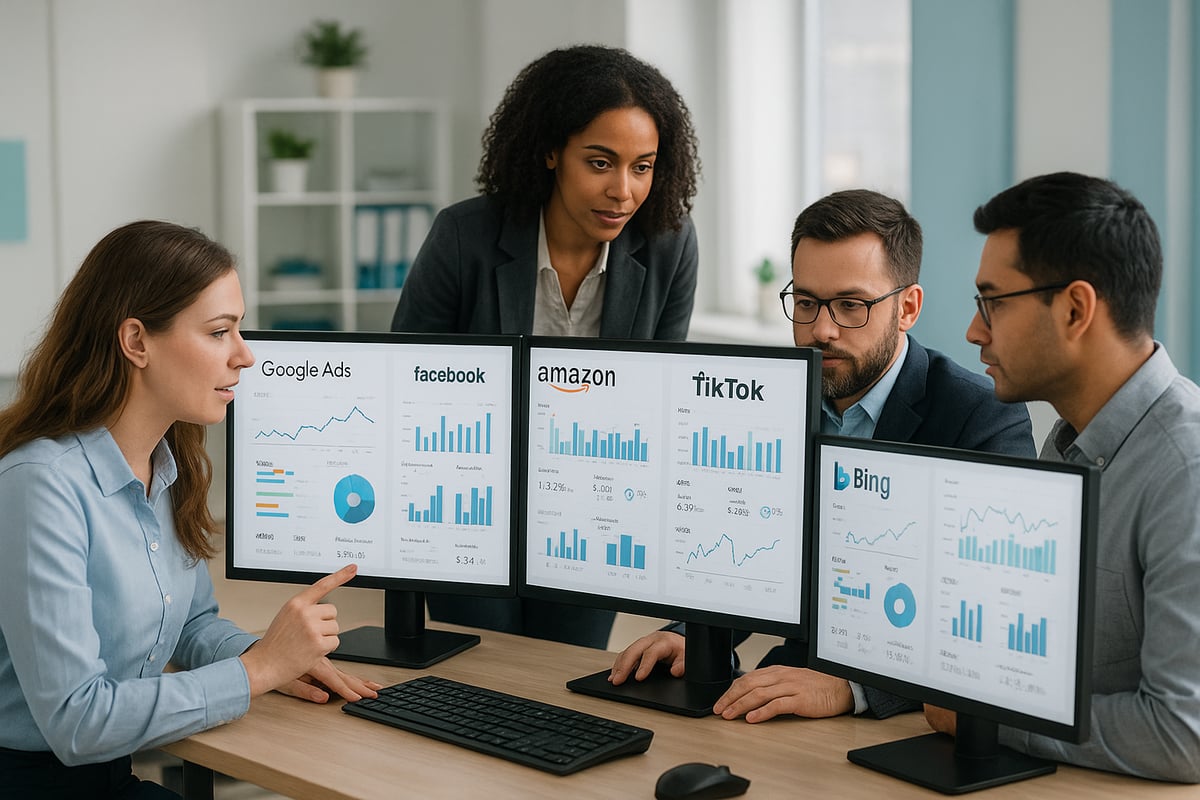
Selecting the right platforms is essential for successful ppc marketing in 2026. Each platform offers distinct advantages, targeting options, and unique audiences. Understanding their strengths will help you allocate your budget and maximise your campaign impact.
Google Ads
Google Ads remains the most powerful engine for ppc marketing, providing access to the largest search, display, shopping, and video ad inventory. In 2026, advanced AI-driven features, such as automated bidding and audience targeting, make campaign management even more efficient.
Integration with YouTube and Google Shopping enables an omnichannel approach, letting brands reach consumers at multiple touchpoints. For practical strategies, explore Google Ads PPC strategies to unlock the full potential of your campaigns.
Microsoft Advertising (Bing)
Microsoft Advertising offers access to a distinct user base, often with less competition compared to Google. This platform is ideal for brands seeking to diversify their ppc marketing and reach audiences who may not use Google as their primary search engine.
Seamless import of Google Ads campaigns streamlines management and allows for quick scaling. Running parallel campaigns can help identify new opportunities and optimise overall ROI.
Meta Ads (Facebook & Instagram)
Meta Ads, covering both Facebook and Instagram, are essential for B2C ppc marketing. Their advanced targeting options let you build custom, lookalike, and retargeted audiences with precision.
Creative formats such as carousel, stories, and video ads boost engagement. Meta’s robust analytics empower you to refine strategies and achieve measurable results, especially for product launches and retargeting campaigns.
Amazon Ads
For e-commerce brands, Amazon Ads is indispensable. It connects your products directly with purchase-ready audiences as they search and browse within the marketplace.
Product-based ads appear in search results and on product pages, driving high-intent traffic. Leveraging Amazon’s ppc marketing tools can quickly boost visibility for new products and increase sales velocity.
TikTok Ads
TikTok Ads are rapidly growing in influence, especially for brands targeting Gen Z and mobile-first users. The platform’s AI-driven targeting ensures your ads reach highly engaged, relevant audiences.
Creative, native-style video ads foster authentic brand connections and can spark viral engagement. TikTok’s unique approach to ppc marketing makes it a valuable addition to any digital strategy focused on awareness and engagement.
Platform Selection Strategy
Choosing the right platforms for your ppc marketing depends on your business goals, audience behaviour, and product or service type. Assess the strengths of each platform and consider combining them for a multi-channel approach.
Use analytics to guide your spend allocation, ensuring you reach potential customers efficiently. Diversifying your investments across multiple platforms increases reach and reduces risk, helping your campaigns stay agile in the evolving digital landscape.
Step-by-Step Guide to Building a High-Performing PPC Campaign
Launching a successful PPC marketing campaign in 2026 requires a blend of strategic planning, creativity, and data-driven decision-making. Whether you are a seasoned marketer or new to PPC marketing, following a structured process will help you maximise your return on investment and stay ahead of the competition.
Step 1: Define Clear Goals and KPIs
The foundation of any effective PPC marketing campaign is setting clear, measurable objectives. Decide what you want to achieve, such as increasing sales, generating leads, driving sign-ups, or boosting website traffic. Align these goals with your wider business strategy to ensure every click supports your growth.
Choose the right KPIs to track your progress. Common metrics include:
| KPI | Description |
|---|---|
| Click-Through Rate | Percentage of users clicking your ad |
| Conversion Rate | Users completing a desired action |
| Cost Per Acquisition | Average spend to secure a customer |
| Return on Ad Spend | Revenue generated for every pound spent |
For example, an e-commerce business might aim for a 5x ROAS. Campaigns driven by specific goals consistently outperform generic efforts, making this step vital to PPC marketing success.
Step 2: Conduct In-Depth Keyword and Audience Research
Effective PPC marketing starts with understanding your audience and identifying the right keywords. Use tools like Google Keyword Planner or SEMrush to discover high-intent search terms, as well as long-tail keywords that offer cost efficiency.
Segment your audience by demographics, interests, and online behaviours. For instance, an automotive dealer might focus on "used hybrid cars Leicester" to attract local buyers. Analysing competitors can also reveal valuable keyword opportunities.
Long-tail keywords often deliver lower CPC and higher conversion rates. By knowing your audience and selecting precise keywords, your PPC marketing spend will drive more relevant traffic and better results.
Step 3: Craft Compelling Ad Copy and Creative Assets
Your ad copy is the frontline of your PPC marketing campaign. Write headlines and descriptions that clearly communicate benefits and address customer needs. Incorporate strong calls-to-action, such as "Book your free consultation today," and ensure relevant keywords are naturally included.
For display and video campaigns, design visually appealing assets that align with your brand. Personalisation can significantly increase engagement, so tailor your messaging to different audience segments whenever possible.
Remember, the right mix of compelling copy and creative visuals will set your PPC marketing apart from the competition, driving higher click-through and conversion rates.
Step 4: Build Optimised Landing Pages
A seamless user journey is essential for PPC marketing success. Your landing pages must be relevant to the ad content, providing a consistent experience from click to conversion. Optimise these pages for speed and mobile devices, as slow or unresponsive sites can lead to high bounce rates.
Include clear calls-to-action, concise copy, and trust signals such as testimonials or security badges. For example, a "2-for-1 pizza" campaign should lead directly to a dedicated offer page.
Fast-loading, well-designed landing pages not only improve user experience but also increase your Quality Score, lowering costs and boosting PPC marketing ROI.
Step 5: Select the Right Bidding Strategy
Choosing an effective bidding strategy is crucial in PPC marketing. Decide between manual bidding, automated bidding, or smart bidding options based on your goals. Manual bidding allows granular control, while automated and smart strategies leverage machine learning for efficiency.
Popular strategies include:
- Target CPA (Cost Per Acquisition)
- Maximise Clicks
- Target ROAS (Return on Ad Spend)
Monitor and adjust your bids as performance data comes in. For lead generation, target CPA bidding can help control costs, while e-commerce businesses may prefer ROAS-focused approaches. For a deeper dive into how AI is transforming campaign management, see this resource on AI-powered campaign management in PPC.
Step 6: Set Budget and Targeting Parameters
Allocate your PPC marketing budget wisely across campaigns, ad groups, and platforms. Define geo-targeting to focus on specific locations, set device targeting to reach users on mobile or desktop, and schedule ads for optimal times of day.
Granular targeting can significantly reduce wasted spend by ensuring ads reach only the most relevant audiences. Balance your investment to maximise both reach and ROI, adjusting allocations as performance data becomes available.
Accurate budget and targeting settings ensure that every pound spent on PPC marketing delivers measurable value.
Step 7: Launch, Monitor, and Optimise Campaigns
After launching your PPC marketing campaign, continuous monitoring is essential. Use A/B testing to compare different ad copies, creatives, and landing pages. Track key metrics such as CTR, conversion rate, CPA, and Quality Score.
Implement negative keywords to filter out irrelevant traffic, and refine your targeting based on performance insights. Regularly pause underperforming ads and reallocate budget to top performers.
Consistent optimisation is the cornerstone of long-term PPC marketing success. By adapting to real-time data and market trends, you can keep your campaigns efficient and ahead of the competition.
Advanced PPC Strategies and Trends for 2026
Staying ahead in ppc marketing requires more than basic tactics. The landscape in 2026 is shaped by rapid advancements, changing consumer expectations, and new regulatory challenges. To secure measurable results, marketers must embrace forward-thinking strategies that leverage technology, data, and creativity.
AI and Automation in PPC
Artificial intelligence is revolutionising ppc marketing by automating complex tasks and boosting campaign efficiency. In 2026, machine learning algorithms handle bid management, audience targeting, and creative selection, reducing manual workload and minimising human error.
Platforms like Google Ads now offer Performance Max campaigns, which automatically optimise ad assets and placements in real time. These smart systems analyse user intent, device usage, and contextual signals to maximise conversions. Automated bidding strategies, such as target CPA and ROAS, help advertisers achieve their goals while maintaining cost control.
For those seeking to understand how AI-driven bidding and automation are reshaping the industry, Emerging PPC trends in 2026 provides valuable insights. As automation becomes the standard, marketers who adapt quickly will see improved scalability and stronger ROI.
Audience Segmentation and Personalisation
Success in ppc marketing now hinges on reaching the right person with the right message at the right time. Advanced audience segmentation enables brands to create micro-targeted campaigns based on demographics, online behaviour, and intent signals.
First-party data is increasingly important, especially with privacy changes limiting third-party cookies. Marketers use CRM and site analytics to build detailed audience profiles, enabling tailored ad experiences. Personalisation goes beyond basic name insertion, delivering unique offers, creatives, and landing pages for each segment.
For example, retargeting users who abandoned their cart with a customised discount code can significantly lift conversion rates. Personalised campaigns not only improve performance but also foster brand loyalty in the competitive ppc marketing space.
Cross-Channel and Omnichannel PPC
Modern consumers interact with brands across multiple touchpoints, making cross-channel strategies essential for effective ppc marketing. Integrating campaigns across search, social, display, and video platforms ensures consistent messaging and maximises reach.
Omnichannel tracking enables marketers to follow the customer journey, from initial ad click to final purchase. Using unified attribution models, brands can measure the impact of each channel and optimise spend accordingly. For instance, a user may first see a Facebook ad, conduct a Google search, and then convert via a shopping ad.
Research shows that omnichannel ppc marketing strategies can increase conversions by up to 30 percent. For more information on investment trends and market share, Digital advertising spend statistics offers up-to-date data on platform performance.
Leveraging Data and Analytics for Optimisation
Data-driven decision-making is at the heart of successful ppc marketing in 2026. Marketers rely on advanced analytics platforms to monitor performance, identify trends, and uncover new opportunities. Conversion tracking, attribution modelling, and cohort analysis provide granular insights into what drives results.
By analysing key metrics such as CTR, CPA, and customer lifetime value, advertisers can refine targeting, adjust bids, and allocate budgets more effectively. Automated reporting tools offer real-time feedback, enabling rapid optimisation.
E-commerce brands, for example, use analytics to identify top-performing keywords and audience segments, ensuring their ppc marketing investment delivers maximum ROI. Embracing a data-first mindset is now essential for staying ahead of the competition.
Creative Testing and Ad Innovation
Innovation in ad creative is a powerful lever for ppc marketing success. Regular testing of new formats, messaging angles, and visual styles keeps campaigns fresh and engaging. Interactive and immersive experiences, such as augmented reality and video, are increasingly popular.
Brands experiment with different headlines, CTAs, and imagery to see what resonates with their audience. TikTok, for example, has popularised brand challenge ads that drive viral engagement. A/B testing allows marketers to compare performance and iterate quickly.
Creative experimentation not only improves engagement but also helps brands stand out in crowded ad spaces. In ppc marketing, those willing to push boundaries are rewarded with higher click-through rates and stronger brand recall.
Navigating Privacy, Regulation, and AI Ethics
Compliance and ethical considerations are now central to ppc marketing. With stricter privacy laws like GDPR and evolving cookie restrictions, brands must prioritise transparent data practices and consent-based tracking. This shift makes first-party data and contextual targeting more valuable than ever.
AI-driven ad delivery introduces new ethical challenges. Advertisers must ensure their algorithms are fair, unbiased, and transparent. Building trust with consumers requires clear communication about how data is collected and used.
Marketers who proactively address privacy and ethical issues will differentiate themselves and protect their reputation in the ppc marketing landscape. Staying informed about regulatory changes and adopting best practices is essential for long-term success.
Future-Proofing Your PPC Strategy
To remain competitive in ppc marketing, adaptability is key. The digital landscape will continue to evolve, with emerging platforms, technologies, and consumer behaviours reshaping best practices. Investing in ongoing learning, upskilling, and staying connected with industry trends ensures your strategies remain relevant.
Brands should regularly review their tech stack, experiment with new tools, and anticipate shifts in audience preferences. By fostering a culture of innovation and agility, marketers can future-proof their ppc marketing efforts and drive sustained growth.
Why Work with a Digital Agency for PPC Success?
Partnering with a digital agency for ppc marketing gives your business a competitive edge. You gain access to experienced professionals, advanced analytics tools, and continuous campaign optimisation tailored to your goals.
Agencies deliver bespoke ppc marketing strategies, seamlessly integrating web design, SEO, and analytics for holistic digital growth. Their hands-on management and transparent reporting ensure your campaigns are always performing at their best. If you are considering agency support, explore the top pay-per-click companies to find the right fit for your needs.
Local businesses often see a measurable increase in leads and sales thanks to agency-managed ppc marketing. For a results-driven approach, contact Ruff Idea and unlock your next level of digital success.
After exploring the latest PPC strategies and how they can transform your digital presence in 2026, you might be wondering how to put these insights into action for your own business. At Ruff Idea, we understand that every brand is unique—whether you’re running a boutique shop or managing a growing e commerce store, your goals deserve a tailored approach. Our team blends expert web design, SEO, and ongoing support to ensure your campaigns deliver real, measurable results. If you’re ready to boost your online performance and outpace the competition, Get in touch—let’s shape your PPC success together.