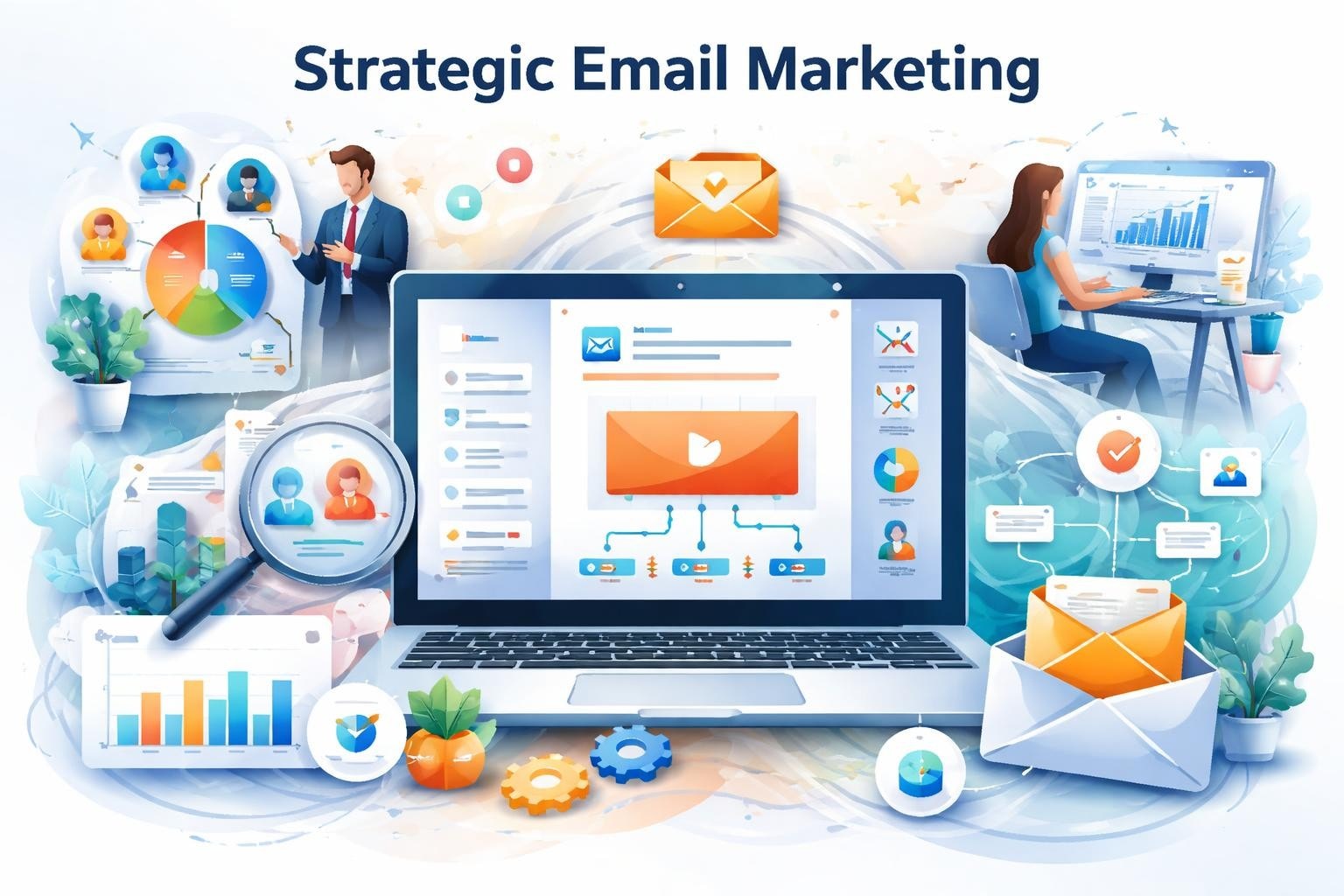
Email remains one of the most powerful marketing channels available to businesses in 2026, delivering an average return of £35 for every pound spent. Yet many companies struggle to maximise this potential, juggling content creation, list management, compliance requirements, and performance tracking whilst managing their core operations. This is precisely where partnering with an email marketing agency can transform your approach, bringing specialist expertise and proven strategies that drive measurable results. Whether you're a Leicestershire boutique looking to nurture customer relationships or an e-commerce brand scaling your digital presence, understanding how agencies work can help you make informed decisions about your marketing investment.
Understanding What an Email Marketing Agency Delivers
An email marketing agency provides comprehensive services that extend far beyond simply sending promotional messages to your subscriber list. These specialists bring strategic thinking, technical expertise, and creative execution to every campaign.
Core Services and Strategic Capabilities
Professional agencies typically offer a multi-layered approach to email marketing. They handle everything from initial strategy development to ongoing optimisation, ensuring your campaigns align with broader business objectives.
Strategic planning forms the foundation of effective agency work. This involves:
- Audience research and segmentation analysis
- Customer journey mapping across touchpoints
- Campaign calendar development aligned with business goals
- Integration planning with existing marketing channels
- Compliance auditing for GDPR and PECR regulations
Creative and technical execution brings strategies to life through expertly crafted campaigns. Agencies employ designers, copywriters, and developers who specialise in email, understanding the unique constraints and opportunities of the medium. They create responsive templates that display beautifully across devices, write compelling subject lines that improve open rates, and develop calls-to-action that drive conversions.

Data Management and List Optimisation
One of the most valuable services an email marketing agency provides is sophisticated list management. Effective email marketing requires clean, well-segmented lists that respect subscriber preferences whilst maximising engagement opportunities.
Agencies implement systematic processes for:
- List hygiene protocols removing inactive subscribers
- Preference centre development allowing granular opt-in choices
- Re-engagement campaigns targeting dormant contacts
- Progressive profiling gathering data over time
- Behavioural segmentation based on user actions
| List Management Task | Agency Benefit | Business Impact |
|---|---|---|
| Regular list cleaning | Improved deliverability rates | Higher inbox placement |
| Segmentation strategy | Targeted messaging | Increased engagement |
| Compliance monitoring | Legal protection | Reduced risk |
| Database integration | Unified customer view | Better personalisation |
This meticulous approach to data management ensures your messages reach engaged audiences whilst maintaining sender reputation, a critical factor for long-term email success.
Selecting the Right Email Marketing Agency for Your Business
Choosing an agency partner requires careful evaluation of capabilities, experience, and cultural fit. Not all agencies operate with the same approach or specialise in the same sectors.
Evaluating Agency Expertise and Track Record
Begin by examining the agency's proven experience within your industry or with similar business models. An agency that has successfully managed campaigns for e-commerce brands will understand cart abandonment sequences, product recommendation engines, and seasonal promotional strategies. Conversely, a service-based business might benefit more from an agency experienced in lead nurturing and relationship marketing.
Request specific examples of their work, focusing on measurable outcomes rather than creative aesthetics alone. Reviewing case studies provides insight into how agencies approach challenges and deliver results for their clients.
Key questions to ask prospective agencies include:
- What industries do you specialise in?
- Can you share campaign performance benchmarks?
- How do you approach strategy development?
- Which email platforms do you work with?
- What reporting and analytics do you provide?
- How do you stay current with deliverability best practices?
Technology Stack and Platform Expertise
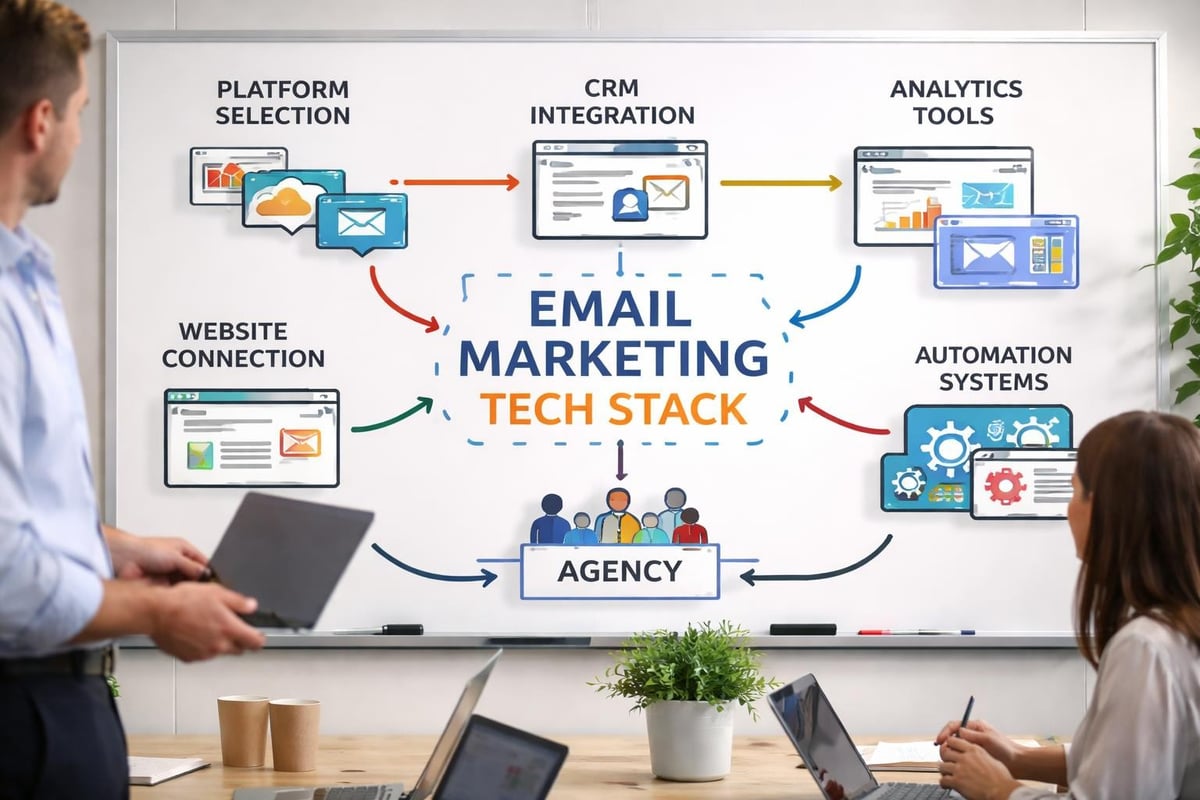
Different email marketing platforms offer varying capabilities, pricing structures, and integration options. Your chosen agency should demonstrate deep expertise with platforms appropriate for your business scale and technical requirements.
Small to medium businesses might benefit from agencies specialising in user-friendly platforms like Mailchimp or MailerLite, whilst larger organisations with complex requirements may need specialists in enterprise solutions such as Salesforce Marketing Cloud or HubSpot.
The agency should also articulate how they integrate email marketing with your existing technology ecosystem, including your website, CRM system, e-commerce platform, and analytics tools. For businesses working with digital partners like those offering expert web design with SEO optimisation, this integration becomes particularly important for creating cohesive customer experiences.
Strategic Approaches That Drive Email Marketing Success
Professional agencies employ sophisticated strategies that go beyond basic promotional sends, creating comprehensive programmes that nurture relationships and drive sustainable growth.
Personalisation and Segmentation Strategies
Modern email marketing thrives on relevance, and agencies excel at creating personalised experiences at scale. They develop segmentation strategies based on multiple data points, including demographic information, behavioural patterns, purchase history, and engagement levels.
Advanced personalisation techniques include:
- Dynamic content blocks changing based on recipient characteristics
- Predictive send-time optimisation for individual subscribers
- Behavioural triggers responding to specific user actions
- Personalised product recommendations using AI algorithms
- Location-based content for geographically dispersed audiences
These approaches significantly outperform generic broadcast messages. Research consistently shows that segmented campaigns achieve 14.31% higher open rates and 100.95% higher click-through rates compared to non-segmented sends.
Automation and Customer Journey Development
Email marketing agencies design sophisticated automation workflows that guide subscribers through carefully crafted journeys. Rather than relying solely on manual campaign sends, they build systems that respond intelligently to subscriber behaviour.
A typical e-commerce automation programme might include:
| Automation Type | Trigger Event | Purpose | Average Performance |
|---|---|---|---|
| Welcome series | New subscription | Introduce brand and set expectations | 50-60% open rate |
| Browse abandonment | Product page visit without purchase | Remind and incentivise | 15-20% conversion |
| Cart abandonment | Items added but checkout incomplete | Recover lost sales | 8-12% recovery rate |
| Post-purchase | Transaction completion | Build loyalty and encourage reviews | 40-50% open rate |
| Re-engagement | Declining activity | Reactivate dormant subscribers | 10-15% reactivation |
These automated sequences work continuously in the background, delivering timely, relevant messages that would be impossible to manage manually at scale.
Content Creation and Optimisation Best Practices
The content within your emails determines whether subscribers engage, ignore, or unsubscribe. Email marketing agencies bring copywriting and design expertise specifically tailored to the email medium.
Crafting Compelling Email Content
Professional agencies understand that email requires a different approach than website copy or social media content. They craft messages that acknowledge the intimate nature of the inbox whilst respecting subscribers' limited attention.
Effective email newsletters follow established best practices that balance informational value with promotional messaging. Agencies typically recommend an 80/20 split, where 80% of content provides genuine value through education, entertainment, or useful resources, whilst only 20% directly promotes products or services.
Subject line development receives particular attention from agencies. They employ various techniques to improve open rates:
- A/B testing different approaches and lengths
- Personalisation tokens incorporating subscriber names
- Curiosity-generating phrases that encourage opens
- Urgency indicators when genuinely appropriate
- Emoji usage for appropriate audiences and contexts
The best agencies avoid manipulative tactics like false urgency or misleading subject lines, understanding that sustainable success requires trust and genuine value delivery.
Design Principles for Maximum Impact
Email design presents unique challenges compared to web design. Agencies create templates that render correctly across dozens of email clients, each with different rendering engines and capabilities.
Professional email design prioritises:
- Mobile-first layouts ensuring readability on smartphones
- Clear visual hierarchy guiding eyes to key elements
- Sufficient white space preventing overwhelming layouts
- Accessible colour contrasts meeting WCAG standards
- Single-column designs for optimal mobile rendering
- Strategic use of images balanced with text
Agencies also implement technical best practices like optimised image sizes for fast loading, alt text for images that fail to display, and fallback fonts for clients that don't support web fonts.

Performance Measurement and Continuous Improvement
Data-driven optimisation separates effective email marketing agencies from those simply executing campaigns. Professional agencies establish comprehensive measurement frameworks that track performance and inform strategic decisions.
Essential Metrics and Analytics
Agencies monitor multiple performance indicators across different campaign objectives. Beyond basic open and click rates, they analyse metrics that directly correlate with business outcomes.
Primary performance metrics include:
- Deliverability rate (percentage reaching inboxes)
- Open rate (engagement indicator)
- Click-through rate (interest and relevance)
- Conversion rate (direct business impact)
- Revenue per email (financial performance)
- List growth rate (audience expansion)
- Unsubscribe rate (content satisfaction)
Sophisticated agencies also track secondary metrics like email forwarding rates, social sharing from emails, and time spent reading messages. They establish benchmarks specific to your industry and business model, recognising that a 20% open rate might be excellent for one sector but concerning for another.
Testing Methodologies and Optimisation Cycles
Professional email marketing agencies implement systematic testing programmes that continuously improve performance. They don't rely on assumptions about what works but instead validate hypotheses through controlled experiments.
Common testing areas include:
- Subject line variations (wording, length, personalisation)
- Send time optimisation (day of week, time of day)
- Content length (short versus long-form)
- Call-to-action placement and language
- Design templates and layouts
- Segmentation criteria effectiveness
- Frequency testing for optimal sending cadence
Implementing email marketing best practices requires ongoing refinement based on actual performance data rather than generic industry advice. Agencies establish testing calendars that ensure continuous learning whilst maintaining campaign performance.
Compliance and Deliverability Management
Navigating the complex landscape of email regulations and maintaining strong sender reputation requires specialist knowledge that agencies provide as part of their core value proposition.
Regulatory Compliance in 2026
Email marketing in the UK operates under strict regulations including GDPR and the Privacy and Electronic Communications Regulations (PECR). Non-compliance can result in significant fines and reputational damage.
An email marketing agency ensures compliance by:
- Implementing proper consent mechanisms (no pre-ticked boxes)
- Maintaining detailed records of consent
- Providing clear unsubscribe options in every email
- Honouring opt-out requests within required timeframes
- Including accurate sender identification
- Safeguarding subscriber data appropriately
These requirements aren't merely legal obligations but also contribute to better campaign performance. Subscribers who have explicitly consented to receive communications engage more actively than those added to lists through questionable methods.
Maintaining Sender Reputation and Inbox Placement
Even perfectly compliant emails fail if they don't reach subscriber inboxes. Agencies actively manage sender reputation, the invisible score that Internet Service Providers assign to determine whether your emails deserve inbox placement or relegation to spam folders.
| Deliverability Factor | Agency Management Approach | Impact on Inbox Placement |
|---|---|---|
| Authentication protocols | SPF, DKIM, DMARC implementation | Essential foundation |
| Engagement rates | Content optimisation, list hygiene | Strong positive signal |
| Complaint rates | Relevant targeting, easy unsubscribe | Critical negative signal |
| Sending consistency | Strategic calendar planning | Moderate positive signal |
| List quality | Regular cleaning, validation | Strong positive signal |
Agencies monitor deliverability metrics closely, identifying problems before they significantly impact campaign performance. They maintain relationships with ISPs when issues arise and understand the nuances of different email providers' filtering algorithms.
Agency Pricing Models and ROI Considerations
Understanding how email marketing agencies structure their fees helps businesses make informed investment decisions and set appropriate expectations.
Common Pricing Structures
Agencies typically employ one of several pricing models, each suited to different business needs and campaign complexities.
Retainer arrangements provide ongoing services for a fixed monthly fee. This model suits businesses requiring consistent email marketing support, including regular campaign sends, automation management, and strategic consultation. Retainers typically range from £1,500 to £10,000 monthly depending on scope and agency expertise.
Project-based pricing works well for defined initiatives like automation setup, template redesign, or comprehensive strategy development. Projects might range from £3,000 for basic automation implementation to £25,000+ for enterprise-level programme development.
Performance-based models tie agency compensation partially to results, though these remain less common in email marketing than in channels like paid advertising. Challenges in attribution and longer customer journeys make pure performance pricing difficult to implement fairly.
Percentage of ad spend doesn't apply directly to email marketing, but some agencies charge based on list size or number of sends, reflecting the effort required to manage larger programmes.
Calculating Return on Investment
The most successful client-agency relationships focus on ROI rather than simply service costs. Email marketing consistently delivers exceptional returns when executed professionally.
To calculate ROI, track:
- Revenue directly attributed to email campaigns
- Customer lifetime value increases from better nurturing
- Cost savings from automation replacing manual processes
- Improved efficiency compared to in-house management
- Reduced customer acquisition costs through retention
A business investing £3,000 monthly in agency services whilst generating £25,000 in attributed email revenue achieves a direct return of 733%, not accounting for longer-term relationship value or brand building effects.
Building Successful Agency Partnerships
The relationship between business and agency significantly influences campaign success. The most effective partnerships operate as true collaborations rather than vendor relationships.
Setting Clear Expectations and Communication Protocols
Successful agency relationships begin with clearly articulated goals, responsibilities, and success metrics. Establish these parameters during the onboarding process to prevent misunderstandings.
Define expectations regarding:
- Campaign frequency and volume
- Approval processes and timelines
- Content creation responsibilities
- Data access and integration requirements
- Reporting frequency and format
- Response times for questions or requests
Regular communication maintains alignment as business priorities evolve. Most agencies recommend monthly strategic reviews supplemented by weekly operational updates for active programmes.
Providing Agencies with Resources for Success
Agencies produce their best work when equipped with comprehensive information about your business, customers, and objectives. Invest time in thorough briefings covering your brand voice, customer personas, competitive landscape, and strategic priorities.
Essential resources to provide include:
- Brand guidelines and visual assets
- Customer data and purchasing patterns
- Product information and seasonal promotions
- Integration access to required systems
- Feedback on campaign performance and customer reactions
The relationship works best when viewed as a partnership where both parties contribute expertise. You bring deep knowledge of your business and customers; the agency contributes email marketing specialisation and execution capabilities.
For businesses already working with digital partners on comprehensive marketing strategies, ensure your email marketing agency coordinates with these relationships to create cohesive customer experiences across channels.
Emerging Trends Shaping Email Marketing in 2026
Forward-thinking email marketing agencies stay ahead of evolving technologies and consumer expectations, incorporating innovations that enhance campaign effectiveness.
Artificial Intelligence and Machine Learning Applications
AI has moved from experimental to essential in professional email marketing. Agencies now employ machine learning algorithms for:
- Predictive send-time optimisation determining ideal delivery times for individual subscribers
- Subject line generation and performance prediction
- Content recommendations based on subscriber behaviour
- Automated segmentation identifying meaningful audience groups
- Churn prediction identifying at-risk subscribers before disengagement
These technologies enable personalisation at scales previously impossible, treating each subscriber as an individual rather than a segment member.
Interactive Email Experiences
Modern email clients increasingly support interactive elements that transform messages from static announcements into engaging experiences. Progressive agencies incorporate features like:
- Embedded forms allowing subscriptions or registrations without leaving email
- Accordion menus revealing additional content on demand
- Image carousels showcasing multiple products
- Interactive polls gathering subscriber feedback
- Countdown timers creating genuine urgency for time-sensitive offers
Innovative interactive approaches can significantly boost engagement rates, though agencies must implement them thoughtfully with appropriate fallbacks for email clients that don't support advanced features.
Privacy-First Marketing Approaches
Growing privacy awareness among consumers and increasingly restrictive regulations continue shaping email marketing practices. Leading agencies embrace privacy-conscious approaches that build trust whilst maintaining effectiveness.
This includes transparent data collection practices, preference centres offering granular control, zero-party data strategies where subscribers voluntarily share information, and contextual personalisation based on current behaviour rather than extensive historical tracking.
These approaches align with both regulatory requirements and consumer expectations, creating sustainable email programmes that respect individual privacy whilst delivering relevant experiences.
Email marketing remains a cornerstone of digital strategy in 2026, but maximising its potential requires specialist expertise, strategic thinking, and continuous optimisation that most businesses struggle to maintain internally. Whether you're looking to build sophisticated automation workflows, improve campaign performance, or ensure compliance whilst scaling your email programme, partnering with the right agency transforms this channel from a periodic promotional tool into a revenue-generating asset. At Ruff Idea, we understand how email marketing integrates with your broader digital presence, and we're here to help Leicestershire businesses create cohesive online experiences that not only look exceptional but deliver measurable results across every customer touchpoint.