The digital commerce landscape has evolved dramatically over recent years, with online retail becoming increasingly sophisticated and competitive. For businesses seeking to establish or enhance their digital storefronts, partnering with specialist ecommerce agencies offers expertise, resources, and strategic guidance that can prove transformative. These agencies bring together multidisciplinary teams capable of handling everything from platform selection and design to marketing and ongoing optimisation, allowing businesses to focus on their core operations whilst specialists drive their online growth.
Understanding What Ecommerce Agencies Deliver
Ecommerce agencies specialise in building and scaling online retail operations through a comprehensive range of services tailored to digital commerce. Unlike generalist web developers or marketing firms, these agencies understand the unique challenges of online selling, from payment gateway integration to inventory management synchronisation.
The scope of services typically encompasses several critical areas:
- Platform development and migration across systems like Shopify, WooCommerce, Magento, or BigCommerce
- User experience (UX) design focused specifically on conversion optimisation
- Digital marketing strategies including PPC, email automation, and social commerce
- Technical SEO tailored for product pages and category structures
- Analytics implementation to track customer journeys and sales funnels
- Ongoing support and optimisation based on performance data
What distinguishes excellent ecommerce agencies from adequate ones is their focus on measurable business outcomes rather than merely deliverables. A great ecommerce agency prioritises ROI and revenue, ensuring every design decision and marketing pound spent contributes directly to your bottom line.
The Multidisciplinary Team Structure
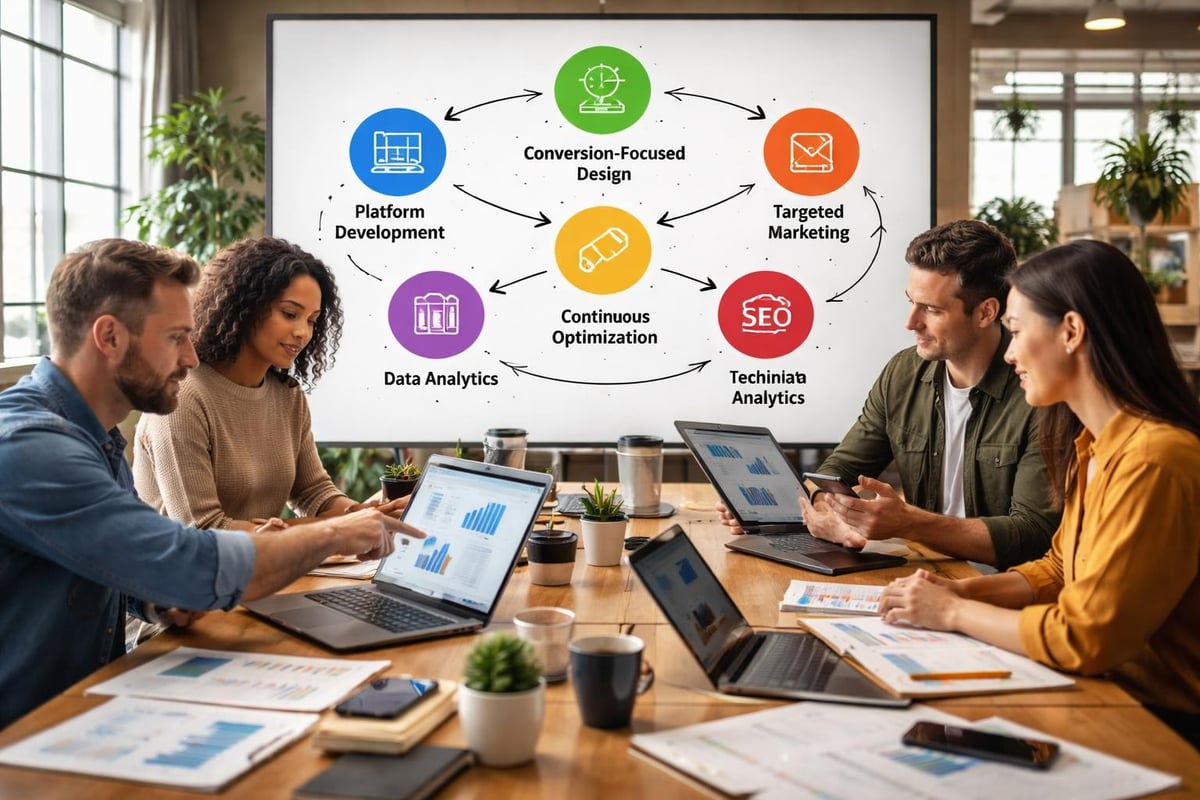
Professional ecommerce agencies assemble teams with diverse expertise that would be prohibitively expensive for most businesses to maintain in-house. A typical project might involve UX designers, front-end developers, back-end engineers, SEO specialists, paid media experts, and project managers working collaboratively.
This team approach ensures comprehensive solutions. Your checkout process doesn't just look appealing-it's optimised for speed, security, and conversion. Your product pages aren't simply informative-they're structured for search visibility whilst incorporating persuasive elements that reduce purchase anxiety.
Identifying When Your Business Needs an Agency Partner
Many businesses reach inflection points where external expertise becomes essential for continued growth. Recognising these moments helps you make strategic decisions about resource allocation.
Consider engaging ecommerce agencies when you're experiencing these situations:
- Platform limitations preventing you from implementing desired features or scaling operations
- Stagnant conversion rates despite increasing traffic to your store
- Technical debt accumulating from quick fixes and temporary solutions
- Resource constraints where your internal team lacks specific expertise
- Competitive pressure from rivals with more sophisticated online experiences
There are scenarios where hiring an agency makes considerably more sense than building internal capabilities, particularly when you need advanced personalisation, complex infrastructure management, or sophisticated data science applications that require specialist knowledge.
The financial consideration also matters. Whilst agencies represent an investment, they often prove more cost-effective than recruiting, training, and retaining full-time specialists, especially for businesses without continuous high-volume work across all disciplines.
Selecting the Right Agency for Your Business
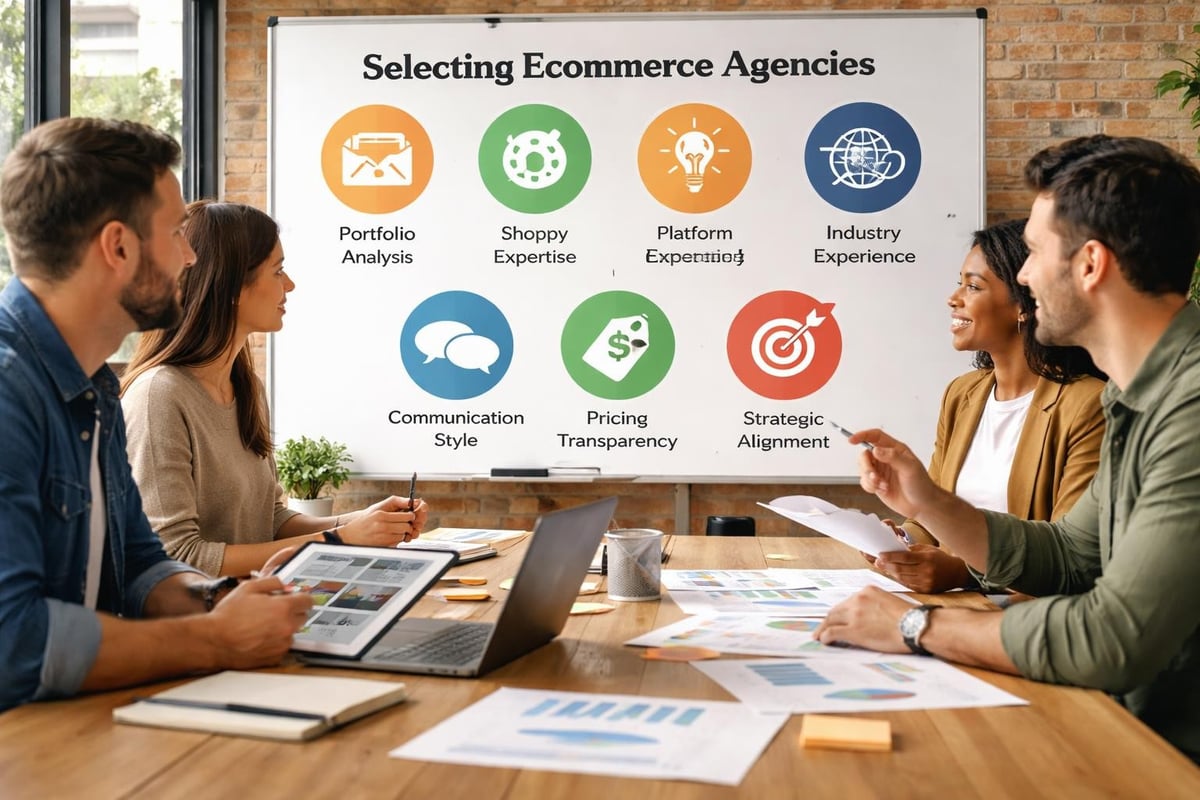
The selection process deserves careful attention, as choosing the wrong partner can result in wasted investment, missed opportunities, and technical complications. Approaching ecommerce agency selection systematically helps ensure alignment between your business objectives and their capabilities.
Evaluating Experience and Expertise
Portfolio review provides crucial insights into an agency's capabilities and aesthetic sensibilities. Look beyond visual appeal to understand the business outcomes achieved-did their work increase conversion rates, reduce bounce rates, or improve average order values?
| Evaluation Criteria | What to Look For | Red Flags |
|---|---|---|
| Portfolio Quality | Diverse projects with measurable results | Generic templates, no case studies |
| Platform Expertise | Deep knowledge of your chosen platform | Jack-of-all-trades approach |
| Industry Experience | Understanding of your specific sector | No relevant category knowledge |
| Technical Capability | Complex integrations and custom solutions | Surface-level implementations |
| Strategic Thinking | Business-focused recommendations | Purely aesthetic focus |
Industry-specific experience matters considerably. An agency that's built successful fashion retail sites understands different challenges than one specialising in B2B wholesale platforms. The user behaviours, purchasing patterns, and technical requirements vary substantially across sectors.
Assessing Communication and Cultural Fit
Technical competence alone doesn't guarantee project success. Communication style, responsiveness, and cultural alignment significantly impact the partnership experience. During initial conversations, evaluate how agencies listen to your challenges, ask clarifying questions, and propose solutions.
Transparency in pricing, timelines, and methodologies indicates professional maturity. Agencies should clearly explain their processes, provide realistic timeframes, and outline what you'll receive at each project stage. When hiring an ecommerce agency, ensure transparent communication structures and clear alignment on business objectives from the outset.
Maximising the Value of Agency Partnerships
Once you've engaged ecommerce agencies, the quality of collaboration significantly influences outcomes. Successful partnerships require active participation from both parties, with clear expectations and regular communication.
Setting Clear Objectives and KPIs
Begin partnerships with explicit goal-setting. Rather than vague aspirations like "improve the website," establish specific, measurable targets:
- Increase conversion rate from 1.8% to 2.5% within six months
- Reduce cart abandonment from 72% to 65%
- Improve mobile page load times to under two seconds
- Achieve first-page rankings for 15 priority product categories
- Grow email list by 25% through optimised capture mechanisms
These concrete metrics provide benchmarks for evaluating success and enable data-driven decision-making throughout the project. They also help agencies prioritise efforts towards activities with the greatest business impact.
Providing Comprehensive Project Information
Agencies perform best when they thoroughly understand your business context. Provide detailed information about your target customers, competitive landscape, brand positioning, inventory systems, and operational constraints. Share access to analytics platforms, customer feedback, and previous performance data.
The more context agencies possess, the better they can tailor solutions to your specific situation rather than applying generic best practices. This might include customer personas, seasonal sales patterns, logistics capabilities, or regulatory requirements affecting your operations.
Core Services That Drive Ecommerce Success
Understanding what ecommerce agencies offer helps you identify which services align with your current priorities and growth objectives.
Conversion Rate Optimisation
Improving the percentage of visitors who complete purchases represents one of the highest-impact activities agencies undertake. Boosting ecommerce conversions involves multiple tactical elements working together-clear navigation hierarchies, fast loading times, compelling product photography, persuasive copywriting, trust signals, and streamlined checkout processes.
Agencies approach this systematically through:
- Heat mapping and session recording to understand user behaviour patterns
- A/B testing of page layouts, calls-to-action, and checkout flows
- Mobile optimisation ensuring seamless experiences across devices
- Page speed enhancement through technical optimisation and infrastructure improvements
- Trust-building elements including reviews, security badges, and clear policies
Even marginal conversion improvements generate substantial revenue impact. Increasing conversion from 2% to 2.5% means 25% more sales from identical traffic levels-a compelling return on optimisation investment.
Search Engine Optimisation for Ecommerce
SEO for online retail requires specialised knowledge beyond standard content marketing. Product pages, category structures, technical architecture, and schema markup all demand ecommerce-specific approaches.
Effective agencies implement comprehensive SEO strategies encompassing:
- Technical foundation including site speed, mobile responsiveness, and crawlability
- Architecture planning creating logical category hierarchies and internal linking
- On-page optimisation for product and category pages with unique, descriptive content
- Schema markup helping search engines understand product information, pricing, and availability
- Content strategy addressing informational queries that bring potential customers into your ecosystem
Following ecommerce website design best practices includes clear product descriptions and detailed specifications that both inform customers and provide search-friendly content, building trust whilst improving organic visibility.

Platform Selection and Development
Choosing the right ecommerce platform represents a foundational decision affecting long-term flexibility, scalability, and operational efficiency. Agencies guide this selection based on your specific requirements:
| Platform Type | Best For | Considerations |
|---|---|---|
| Shopify | Rapid deployment, ease of use | Monthly fees, transaction costs |
| WooCommerce | WordPress integration, flexibility | Requires technical management |
| Magento | Large catalogues, complex requirements | Higher development costs |
| BigCommerce | Growing businesses, built-in features | Learning curve for customisation |
| Custom Solutions | Unique requirements, full control | Significant investment required |
Beyond platform selection, agencies handle implementation, customisation, and integration with your existing business systems-from accounting software to inventory management and customer relationship platforms.
Budgeting for Agency Partnerships
Financial planning for agency work requires understanding how ecommerce agencies structure pricing and what factors influence investment levels. Setting realistic budgets and carefully reviewing proposals ensures you secure appropriate services without overspending.
Pricing Models Explained
Agencies typically offer several pricing structures:
Project-based pricing suits defined initiatives like platform migrations or website redesigns. You receive a fixed quote for specific deliverables, providing budget certainty. This works well for businesses with clear requirements and limited ongoing needs.
Retainer arrangements provide ongoing support, optimisation, and marketing services for monthly fees. This model suits businesses requiring continuous improvement and regular agency access. Retainers often prove more cost-effective for sustained relationships than project rates.
Performance-based pricing links agency compensation to results achieved, such as revenue increases or conversion improvements. Whilst potentially attractive, ensure metrics are clearly defined and that agencies have sufficient control over relevant variables to influence outcomes.
Investment Expectations by Project Type
Basic ecommerce websites might start from £5,000 to £15,000, whilst comprehensive platforms with custom functionality, extensive product catalogues, and sophisticated integrations can require £50,000 to £150,000 or more. Marketing services typically range from £1,000 to £10,000 monthly depending on scope and channels.
Remember that cheaper isn't necessarily better. Agencies pricing significantly below market rates may lack experience, cut corners on quality, or struggle to provide adequate support. Evaluate value rather than simply seeking the lowest price.
Measuring Agency Performance and ROI
Establishing accountability mechanisms ensures agencies deliver promised results and enables you to assess partnership value objectively.
Key Performance Indicators to Monitor
Track metrics across several dimensions:
Commercial metrics directly reflecting business impact:
- Revenue and revenue growth
- Conversion rate improvements
- Average order value trends
- Customer acquisition cost
- Customer lifetime value
Engagement metrics indicating user experience quality:
- Bounce rate and exit rate patterns
- Time on site and pages per session
- Cart abandonment rates
- Return visitor percentages
Technical metrics affecting performance:
- Page load speeds
- Mobile usability scores
- Error rates and downtime
- Search engine rankings
Request regular reporting from agencies covering these areas, with clear explanations of what's driving changes and what optimisations are planned.
Continuous Improvement Cycles
The best agency relationships involve ongoing refinement rather than "set and forget" approaches. After initial launches, data-informed iteration progressively improves performance. Monthly or quarterly reviews should examine results, identify opportunities, and adjust strategies accordingly.
If you're seeking digital marketing support near your location, consider how proximity affects collaboration quality and whether local agencies better understand regional market characteristics relevant to your business.
Navigating Common Agency Partnership Challenges
Even well-matched partnerships encounter obstacles. Anticipating potential issues and establishing resolution mechanisms helps maintain productive relationships.
Managing Scope Creep
Projects sometimes expand beyond initial agreements as new ideas emerge or requirements become clearer. Whilst some flexibility proves beneficial, uncontrolled scope creep creates budget overruns and timeline delays.
Address this through formal change request processes. When additional work is proposed, evaluate it against project priorities and obtain updated quotes and timelines before proceeding. This maintains transparency and prevents misunderstandings.
Balancing Speed and Quality
Businesses naturally want rapid results, but rushing development often creates technical debt and suboptimal solutions. Professional agencies push back against unrealistic timelines when necessary, explaining the risks of compressed schedules.
Trust agency guidance on timeframes whilst clearly communicating your business drivers. If an upcoming peak season creates urgency, agencies can potentially phase deliveries, launching core functionality quickly whilst refining secondary features subsequently.
Maintaining Knowledge Transfer
Avoid becoming entirely dependent on agencies by ensuring knowledge transfer occurs throughout projects. Request documentation, training sessions, and explanation of systems implemented. This enables your team to handle routine updates and minor modifications internally, reserving agency time for complex challenges.
Future-Proofing Your Ecommerce Investment
Technology and consumer behaviours evolve constantly. Agencies should build adaptable solutions that accommodate future developments rather than requiring complete rebuilds as needs change.
Emerging Trends Shaping Ecommerce
Forward-thinking ecommerce agencies incorporate consideration of developing trends into their recommendations:
- Headless commerce architectures separating front-end presentation from back-end functionality for greater flexibility
- Progressive web applications providing app-like experiences through browsers
- Voice commerce optimisation as smart speaker usage grows
- Augmented reality integration helping customers visualise products
- Artificial intelligence personalisation tailoring experiences to individual preferences
- Sustainability features addressing growing consumer environmental consciousness
Whilst not every business needs cutting-edge technology immediately, your platform and architecture should accommodate these capabilities as they become commercially relevant to your sector.
Scalability Considerations
Your chosen solutions should scale alongside business growth. This means selecting platforms that handle increased traffic, larger catalogues, and higher transaction volumes without performance degradation. It also means architectural decisions that don't require complete rebuilds as you expand.
Discuss scalability explicitly during agency selection. Ask how their proposed solutions accommodate 10x growth in products, traffic, or orders. Agencies experienced with growing businesses understand these considerations and build accordingly.
The Strategic Value of Specialist Expertise
Ultimately, engaging ecommerce agencies represents strategic investment in capabilities that drive competitive advantage. The digital commerce environment grows increasingly sophisticated, with customer expectations continuously rising. Agencies dedicated to this space stay current with platform updates, emerging best practices, and evolving consumer behaviours.
This specialisation delivers value that generalist providers cannot match. They've encountered and solved problems similar to yours across multiple clients, bringing proven solutions rather than experimental approaches. They maintain relationships with technology vendors, accessing beta features and technical support channels unavailable to individual businesses.
For growing businesses, this expertise accelerates progress towards objectives whilst avoiding costly mistakes that inexperienced implementation creates. The investment in professional agency support typically generates returns many times the initial outlay through improved conversion rates, increased traffic, and enhanced operational efficiency.
Selecting and partnering with the right ecommerce agency can fundamentally transform your online retail performance, bringing specialist expertise that drives measurable business growth. At Ruff Idea, we understand the unique challenges facing growing e-commerce brands and combine expert web design with SEO optimisation and ongoing support to create online stores that not only look exceptional but deliver strong commercial results. Whether you're launching your first digital storefront or scaling an established operation, our Leicestershire-based team is ready to help you build a high-performing ecommerce presence.