In 2026, the digital marketplace is more intense than ever. With just 50 milliseconds to impress, your website’s first impression can determine your business’s fate.
This guide will show you how to design e commerce website that stands out, converts visitors into loyal customers, and stays ahead of the competition.
You will discover the latest trends, actionable strategies, and essential innovations shaping e-commerce success. From strategic planning and user experience to mobile-first approaches and future-proofing, every crucial element is covered.
Ready to build a visually stunning, high-performing store trusted by customers? Follow this step-by-step guide to unlock your e-commerce potential in 2026.
Understanding the 2026 E-Commerce Landscape
In 2026, the race to design e commerce website platforms that stand out is more intense than ever. E-commerce is rapidly evolving, shaped by new technologies and changing consumer demands. To succeed, businesses must stay ahead of trends, understand buyer expectations, and learn from industry leaders.

Key Industry Trends Shaping E-Commerce Success
The drive to design e commerce website platforms for 2026 is fuelled by several key industry trends. Global online retail continues its rapid expansion, with over 60% of all transactions taking place on mobile devices. This surge highlights the need for mobile-first strategies and seamless user experiences across every device.
Artificial intelligence and automation are at the forefront, revolutionising personalisation, product recommendations, and customer support. Brands are leveraging AI to deliver tailored shopping journeys and dynamic content. Omnichannel experiences have become essential, as customers demand smooth transitions between platforms, from desktop to mobile and even in-store.
Security and speed are now non-negotiable. Shoppers expect lightning-fast load times and robust data protection at every step. Meanwhile, eco-conscious and ethical purchasing is influencing both design and branding, with consumers seeking out brands that reflect their values.
Emerging technologies such as voice commerce and visual search are gaining momentum, offering new and intuitive ways to shop. The influence of Web3 and decentralised solutions is also growing, particularly around payments and data privacy. For a deeper dive into how user experience and interface design are evolving, see the latest UX/UI trends in e-commerce 2026.
Consumer Behaviour and Expectations
Understanding how to design e commerce website experiences that meet customer expectations is vital in 2026. Today’s shoppers demand fast, frictionless checkout processes, with cart abandonment rates still hovering near 70%. Reducing barriers to purchase is critical for maximising conversions.
Trust plays a crucial role in the decision-making process. Displaying authentic reviews, clear policies, and secure payment options helps establish credibility. Shoppers are also drawn to highly visual, interactive product displays, including AR and VR try-ons, which allow them to engage with products before buying.
Modern consumers prefer brands that communicate transparency, authenticity, and clear values. They respond to businesses that not only offer great products but also align with their social and ethical principles. Ultimately, these expectations shape the way you design e commerce website features and content.
Competitive Benchmarks and Inspiration
To design e commerce website platforms that perform at the highest level, it’s essential to learn from industry leaders. Top-performing sites like Allbirds, Kylie Cosmetics, and KITH set the standard with innovative design choices, intuitive navigation, and compelling storytelling.
Analysing industry reports and competitor case studies provides valuable insights into what works and why. For example, brands that invest in high-quality imagery, streamlined checkouts, and bold branding consistently outperform their peers. Reviewing these benchmarks enables you to identify opportunities for differentiation and continuous improvement.
By studying successful examples, you can adapt proven strategies to your own business, ensuring your e-commerce website is not only visually appealing but also optimised for conversion and loyalty.
Step 1: Strategic Planning and Platform Selection
Successful e-commerce starts with clear direction. Before you design e commerce website, it is essential to build a strong foundation. Strategic planning ensures every decision supports your business goals and delivers a seamless experience to your customers.

Defining Your E-Commerce Goals and Audience
The first step to design e commerce website is setting measurable objectives. Define what success looks like for your business. Are you targeting higher conversion rates, increased average order value, or stronger customer loyalty?
Identify your primary and secondary customer personas. Understand their needs, preferences, and buying behaviours. Map out the customer journey, from their first visit to post-purchase engagement. This clarity will help align every design and feature with real customer expectations.
Knowing your audience also enables you to create messaging and visuals that resonate. For a deeper dive into the foundational elements of outstanding websites, consider reviewing The 10 qualities of a great website.
Choosing the Right E-Commerce Platform
Selecting the right platform is critical when you design e commerce website. Each solution offers unique strengths. Here’s a quick comparison:
| Platform | Scalability | Customisation | Integrations | Support | Cost |
|---|---|---|---|---|---|
| Shopify | High | Moderate | Extensive | 24/7 | Monthly |
| WooCommerce | High | High | Extensive | Community | Varies |
| Magento | Very High | Very High | Advanced | Enterprise | High |
| BigCommerce | High | Moderate | Extensive | 24/7 | Monthly |
Prioritise scalability, custom features, and reliable support. Ensure the platform offers responsive design and can adapt to emerging trends. Consider integration options for payments, shipping, and marketing tools to future-proof your investment.
Laying the Foundation: Domain, Hosting, and Security
A memorable domain is the cornerstone when you design e commerce website. Choose a name that is short, brand-aligned, and easy to recall.
Reliable hosting is just as important. Opt for providers known for speed and uptime, such as Google Cloud or AWS. Secure hosting, SSL certificates, and PCI-compliant gateways protect both your business and your customers. Here’s a quick checklist:
- Unique, memorable domain name
- Fast, secure hosting provider
- SSL certificate enabled
- PCI-compliant payment gateway
These steps ensure your website is trustworthy and ready for growth.
Planning for SEO and Analytics
Effective planning for SEO is vital as you design e commerce website. Start with keyword research specific to your niche. Structure your site for both users and search engines, using clear navigation and logical categories.
From launch, integrate analytics tools like GA4, heatmaps, and session recordings. This data will help you understand user behaviour and identify opportunities for optimisation. A well-structured site not only attracts more visitors but also converts them efficiently.
Step 2: Crafting a User-Centric Design for Maximum Engagement
First impressions matter when you design e commerce website experiences for 2026. Users form opinions in a blink, making trust and clarity critical from the outset. A user-centric approach ensures every interaction builds credibility, encourages engagement, and sets your brand apart in a crowded digital marketplace.
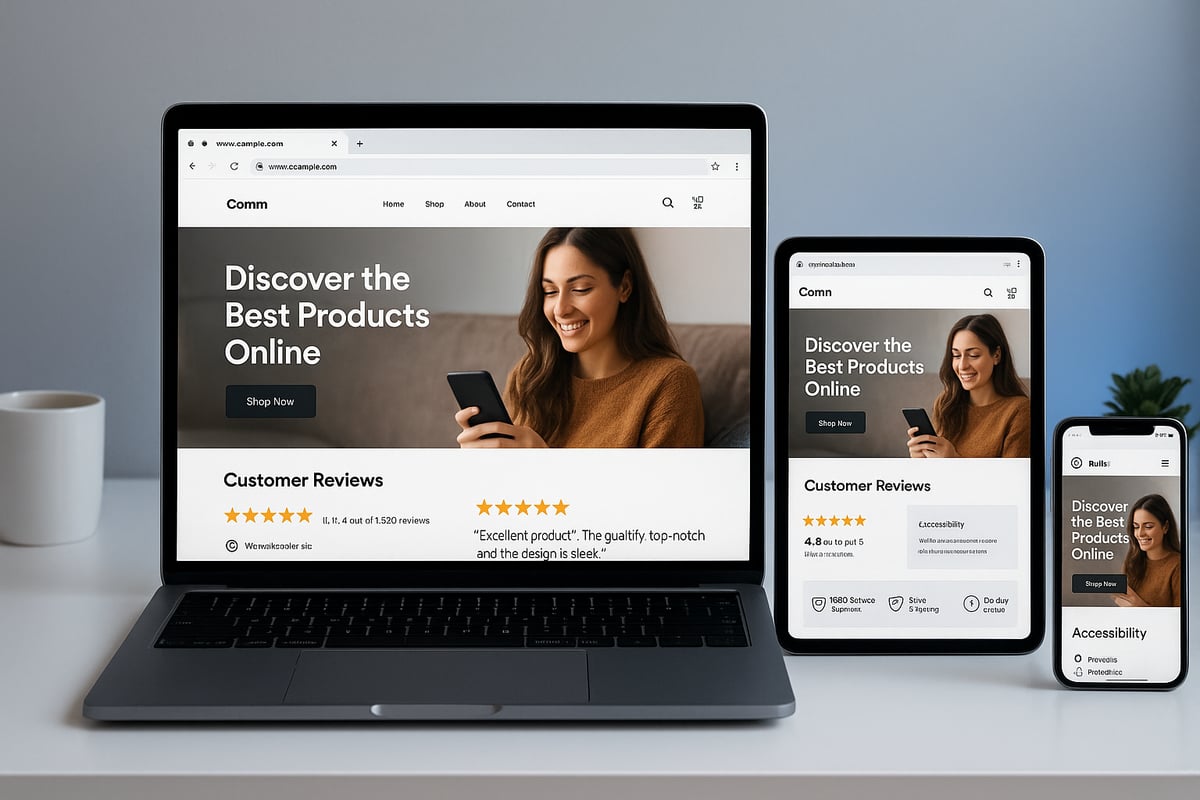
Building Trust and Credibility from the First Click
To design e commerce website platforms that convert, trust must be established immediately. Display your contact information prominently so shoppers know you're accessible. Clear return policies, privacy assurances, and transparent shipping details reduce barriers to purchase.
Social proof is essential. Highlight customer reviews, testimonials, and user-generated content throughout your site. Trust badges, secure payment icons, and recognisable certification marks provide reassurance and increase conversion rates.
Consider these quick trust-building elements:
- Visible customer support options
- Easy-to-find terms and conditions
- Prominent display of SSL and payment security badges
When you design e commerce website features around transparency, you foster credibility and encourage users to take the next step.
Creating a Visually Compelling Experience
A visually engaging site is non-negotiable when you design e commerce website platforms for modern consumers. High-quality product photography, including multiple angles and lifestyle shots, helps shoppers visualise ownership. Interactive zoom features further enhance product understanding.
Consistent branding—using a deliberate colour palette, distinctive typography, and a clear visual hierarchy—builds recognition and trust. Leverage psychological design principles to guide users' attention to calls to action and key information.
For a deeper dive into these best practices, explore these E-commerce web design strategies that can elevate your site’s visual and functional impact.
When you design e commerce website layouts with intention, you create a space that is both visually striking and conversion-focused.
Designing Intuitive Navigation and Site Structure
Seamless navigation is at the core when you design e commerce website experiences that keep visitors engaged. Limit your top-level menu to four to six categories for clarity. Use straightforward labels like Shop, About Us, Contact, and Bestsellers.
Enhance product discovery with breadcrumb trails, smart filters, and robust search functionality. These features help users move effortlessly from browsing to buying.
Don’t overlook footer navigation. Place secondary links—such as FAQs, policies, and support—at the bottom for easy access without cluttering primary menus.
By focusing on intuitive navigation as you design e commerce website architecture, you streamline the customer journey and reduce friction at every step.
Prioritising Accessibility and Inclusivity
Ensuring accessibility is not just a legal requirement but a business imperative when you design e commerce website solutions. Adhere to WCAG 2.2 standards by providing descriptive alt text for images, ensuring sufficient colour contrast, and enabling keyboard navigation.
Design for all users, including those relying on assistive technologies. Responsive layouts and readable fonts make your site welcoming and usable for everyone.
Prioritising inclusivity broadens your audience and demonstrates your commitment to equal access. When you design e commerce website interfaces that everyone can use, you build loyalty and trust across diverse customer groups.
Enhancing Visual Storytelling with Modern UI Elements
Modern UI elements are powerful when you design e commerce website experiences that captivate. Micro-interactions—such as subtle hover effects and animated button feedback—make browsing feel dynamic and engaging.
Integrate video content to showcase products in action or share your brand story. For certain sectors, AR and VR previews allow customers to visualise products in their own environment, bridging the gap between online and in-person shopping.
These interactive features, when thoughtfully integrated as you design e commerce website components, boost engagement and reinforce your brand’s innovative edge.
Case Studies and Examples
Examining successful brands provides inspiration when you design e commerce website solutions. Outdoor Voices shines with lifestyle imagery, minimal fonts, and an aspirational brand narrative that resonates visually. Supergoop builds trust with a comprehensive returns policy and a self-service portal, reducing purchase anxiety.
| Brand | Trust Elements | Visual Strategy | UI Highlights |
|---|---|---|---|
| Outdoor Voices | Clear contact, reviews | Lifestyle imagery | Minimal fonts |
| Supergoop | Return policy, portal | Consistent branding | Self-service features |
By learning from these leaders, you can design e commerce website experiences that blend credibility, engagement, and ease of use.
Step 3: Mobile-First and Responsive Design Principles
In 2026, a mobile-first approach is no longer optional when you design e commerce website for success. With the majority of online shoppers completing transactions on mobile, optimising for smaller screens is the foundation of modern e-commerce. According to Mobile commerce statistics 2025, mobile commerce now accounts for over 60 percent of global e-commerce sales, making responsive design essential for every retailer.
Why Mobile-First Matters in 2026
The shift towards mobile shopping has accelerated rapidly. Today’s consumers expect a seamless experience when they visit any design e commerce website, regardless of device. Mobile-first design ensures your site loads quickly, displays beautifully on all screens, and provides easy navigation.
A mobile-optimised website is also essential for search visibility. Google’s algorithms prioritise mobile-friendly sites in search rankings, so neglecting this aspect can reduce your organic traffic. Brands that invest in mobile-first strategies consistently see higher engagement and improved conversion rates.
Best Practices for Mobile UX/UI
To design e commerce website experiences that delight users, start with a responsive layout. Use flexible grids and media queries to ensure your site adapts fluidly to smartphones, tablets, and desktops. Prioritise large, easily tappable buttons and streamline forms to minimise user effort.
Fast-loading images and lightweight assets are critical. Compress product photos and use modern formats like WebP to reduce load times. Keep navigation simple, enabling customers to browse and purchase with minimal friction.
- Use clear call-to-action buttons
- Minimise menu items for clarity
- Optimise tap targets for all screen sizes
Testing and Optimising for All Devices
Comprehensive testing is vital when you design e commerce website for a diverse audience. Use emulators and real-device testing to verify your site’s appearance and functionality across multiple platforms. Monitor metrics such as load times, conversion rates, and bounce rates to identify areas for improvement.
Gather feedback from real users to uncover pain points in the mobile journey. Regularly review analytics to spot drop-offs and refine the user experience. Continuous optimisation ensures your site remains competitive as new devices and browsing behaviours emerge.
Leveraging Progressive Web Apps (PWAs)
Progressive Web Apps are transforming how brands design e commerce website solutions. PWAs provide an app-like experience in the browser, offering offline access, push notifications, and lightning-fast performance. Customers benefit from instant loading and smooth navigation, even on unreliable connections.
Leading e-commerce brands are adopting PWAs to boost engagement and retention. Consider implementing PWA features to future-proof your website and deliver the high standards modern shoppers expect. PWAs help bridge the gap between traditional websites and native apps, driving measurable results.
Step 4: Conversion Optimisation and Checkout Experience
Maximising conversions is crucial when you design e commerce website for long-term success. Every step, from product discovery to checkout, must be frictionless and persuasive. Let’s break down the key strategies to ensure your site turns visitors into loyal customers.
Streamlining the Path to Purchase
When you design e commerce website for 2026, simplicity is key. Reduce the number of clicks needed from product discovery to checkout. Persistent shopping carts help users pick up where they left off, even across devices.
Consider enabling one-click checkout options. These features, as seen on Shopify, are now industry standard. They remove barriers, speed up transactions, and create a seamless experience.
For actionable strategies, explore these Increase e-commerce sales in 2024 tips, which offer practical ways to streamline the buying journey and boost sales. Always prioritise clarity and speed at every touchpoint as you design e commerce website for optimal results.
Optimising Product Pages for Conversions
Your product pages are where decisions happen. When you design e commerce website, focus on creating clear, concise product descriptions that highlight features and benefits.
Incorporate social proof—ratings, reviews, and bestseller badges build trust instantly. Upselling and cross-selling related products or bundles can lift average order value.
Use high quality images, videos, and interactive elements to show products in use. Make all calls to action prominent, so users know exactly how to proceed.
Designing a Seamless Checkout Process
A smooth checkout can significantly impact conversion rates. Offer guest checkout alongside account creation, giving users freedom of choice.
Support multiple payment methods, including cards, digital wallets, buy now pay later, and local options. Clearly display shipping costs, estimated delivery times, and straightforward return policies.
Remove unnecessary form fields and steps. The fewer obstacles in the checkout, the higher the chance customers will complete their purchase when you design e commerce website.
Reducing Cart Abandonment
Despite best efforts, cart abandonment remains a major challenge, with rates hovering around 70 percent. Implement features like exit intent popups and retargeting emails to re engage potential buyers.
Persistent carts encourage users to return and complete their orders. For up to date industry benchmarks, review these E-commerce conversion rate statistics 2026 to understand where your site stands.
Transparency in pricing and shipping, along with easy returns, can further reduce abandonment. Regularly test new approaches to see what resonates with your audience.
Integrating Analytics for Continuous Improvement
Analytics are essential for ongoing optimisation. Track funnel drop offs, monitor heatmaps, and use A/B testing to experiment with different page elements.
Gather customer feedback directly to identify pain points. Refining your processes based on real data ensures your design e commerce website approach remains effective in a changing market.
Continuous improvement is the hallmark of e commerce leaders. Stay agile and proactive, always seeking new ways to enhance the user journey.
Step 5: Future-Proofing Your E-Commerce Website
Staying ahead in e-commerce means building a website that is ready to adapt, scale, and thrive no matter what the future holds. To truly design e commerce website solutions that stand the test of time, focus on the innovations, technologies, and values shaping the industry in 2026.
Embracing AI, Automation, and Personalisation
To design e commerce website platforms that excel in 2026, AI-driven tools are essential. Artificial intelligence powers personalised product recommendations, dynamic pricing, and predictive search, making each customer journey unique. Automated workflows streamline inventory, order management, and support, dramatically reducing manual effort.
For a deeper look at how AI shapes the future of personalisation, read this AI-powered personalization in e-commerce guide. Leveraging these technologies not only increases conversions but also builds lasting customer loyalty.
Preparing for New Technologies and Channels
The pace of digital innovation is relentless. When you design e commerce website experiences for tomorrow, consider the integration of social commerce, voice search, and AR/VR shopping. Platforms like Instagram and TikTok Shop drive sales directly from social feeds, while voice assistants and visual search change how users discover products.
Web3 and decentralised payment options are reshaping data privacy and transaction security. Keeping your site compatible with these channels ensures you never miss out on emerging audiences.
Ensuring Scalability and Flexibility
A future-proof approach means your design e commerce website strategy must allow for seamless growth. Modular site architecture makes it easy to add new features, update content, and pivot as your business evolves.
Choose platforms and plugins that support robust integration and customisation. Scalability is not just about handling more traffic, but about staying agile as new opportunities and challenges arise.
Sustainability and Ethical Considerations
Modern consumers demand more than convenience; they want to support brands that align with their values. When you design e commerce website solutions, prioritise eco-friendly hosting, green delivery, and transparent sourcing.
Showcase your sustainability commitments through clear messaging and design. Ethical practices not only attract conscious shoppers but also future-proof your brand reputation in an evolving marketplace.
Partnering with Ruff Idea: Bespoke E-Commerce Website Design
Ruff Idea delivers tailored e-commerce solutions for businesses seeking to stand out in a crowded digital space. Our Leicestershire-based team specialises in custom design, SEO, and social media integration, ensuring your online store is both beautiful and effective.

With ongoing support and a focus on measurable results, we help boutiques and growing brands alike achieve lasting e-commerce success. Contact us for a free consultation and discover how we can help your business thrive in 2026 and beyond.
You’ve seen how the right planning, user focused design and future ready features can set your e commerce site apart in 2026. If you’re ready to turn these insights into a real advantage, we’re here to help. At Ruff Idea, we combine creative design, technical know how and ongoing support to build websites that not only look impressive but actually deliver results. Whether you’re starting fresh or looking to elevate an existing store, let’s work together to make your online presence truly stand out.
Get in touch