
Small businesses websites serve as the digital storefront for countless enterprises across the United Kingdom, representing far more than a simple online presence. In 2026, these websites function as powerful marketing tools, customer service platforms, and revenue generators that work around the clock. Whether you operate a boutique clothing shop in Leicestershire, manage a growing e-commerce venture, or run a local trades business, your website directly influences how customers perceive your brand and whether they choose to engage with your services. Understanding the fundamental principles of effective web design, performance optimization, and strategic content placement can transform your online presence from a basic digital placeholder into a competitive business asset that drives measurable results.
The Foundation: Essential Elements Every Small Business Website Needs
Building small businesses websites requires careful attention to fundamental components that visitors expect to find within seconds of landing on your homepage. The navigation structure should provide intuitive pathways to key information, allowing potential customers to find what they need without frustration or confusion.
Contact information deserves prominent placement on every page, not buried in a footer or hidden behind multiple clicks. Research consistently shows that visitors evaluate trustworthiness partly based on how easily they can reach you. Mailchimp’s small business website design tips emphasize placing phone numbers, email addresses, and physical locations where users naturally look for them, typically in the header or as a sticky element that follows scroll behavior.

Your homepage messaging must immediately communicate three critical points:
- Who you are – Clear business name and positioning
- What you offer – Primary products or services presented concisely
- Why visitors should care – Unique value proposition or differentiator
Loading Speed and Technical Performance
Performance metrics directly impact both user experience and search engine rankings. Small businesses websites that load within two seconds see significantly higher engagement rates compared to those requiring four or five seconds. Modern users expect instant gratification, and slow-loading pages trigger immediate abandonment.
| Performance Factor | Target Metric | Business Impact |
|---|---|---|
| Initial Load Time | Under 2 seconds | Reduced bounce rate |
| Time to Interactive | Under 3 seconds | Improved engagement |
| Mobile Performance | 90+ PageSpeed score | Higher mobile conversions |
| Image Optimization | Compressed, modern formats | Faster rendering |
Technical optimization extends beyond basic speed considerations. Implementing proper schema markup helps search engines understand your business context, displaying rich snippets that improve click-through rates from search results. Security certificates (HTTPS) have evolved from optional upgrades to mandatory requirements, with browsers actively warning users away from unsecured sites.
Design Principles That Drive Conversions
Visual hierarchy guides visitor attention toward desired actions, whether booking a consultation, purchasing products, or submitting inquiry forms. Effective small businesses websites leverage contrast, spacing, and strategic color application to create clear pathways through content.
White space serves a functional purpose beyond aesthetic appeal. Dense layouts overwhelm visitors, creating cognitive friction that increases abandonment rates. Business.com’s website design tips highlight how strategic spacing improves readability and comprehension, allowing key messages to resonate more effectively.
Typography choices communicate brand personality while maintaining practical readability across devices. Script fonts might suit creative agencies or wedding planners but often hinder readability for trades businesses or professional services. Hierarchy through font sizing establishes content importance, with headings typically 2-3 times larger than body text.
Mobile-First Responsive Design
Over 60% of web traffic now originates from mobile devices, making responsive design non-negotiable for small businesses websites. The mobile-first approach prioritizes smartphone experiences during the design phase, then scales up for tablets and desktops rather than attempting to compress desktop layouts into smaller screens.
Touch targets require adequate sizing and spacing. Buttons that work perfectly with mouse cursors become frustration points when fingers can't accurately tap them. Industry standards recommend minimum touch target dimensions of 44×44 pixels with surrounding whitespace preventing accidental clicks on adjacent elements.
Navigation patterns must adapt intelligently across screen sizes:
- Desktop: Horizontal menu bars with dropdown menus
- Tablet: Condensed menus or hamburger icons
- Mobile: Full-screen overlays or simplified bottom navigation
Content Strategy and User Engagement
Content serves dual purposes on small businesses websites, addressing both human visitors and search engine algorithms. Strategic keyword integration feels natural rather than forced, appearing in headings, opening paragraphs, and throughout body content where contextually appropriate.
Product or service descriptions require benefits-focused language rather than feature lists. Customers care less about technical specifications than how offerings solve their problems or improve their situations. A landscaping company gains more traction describing "maintenance-free gardens that look stunning year-round" than listing equipment specifications.
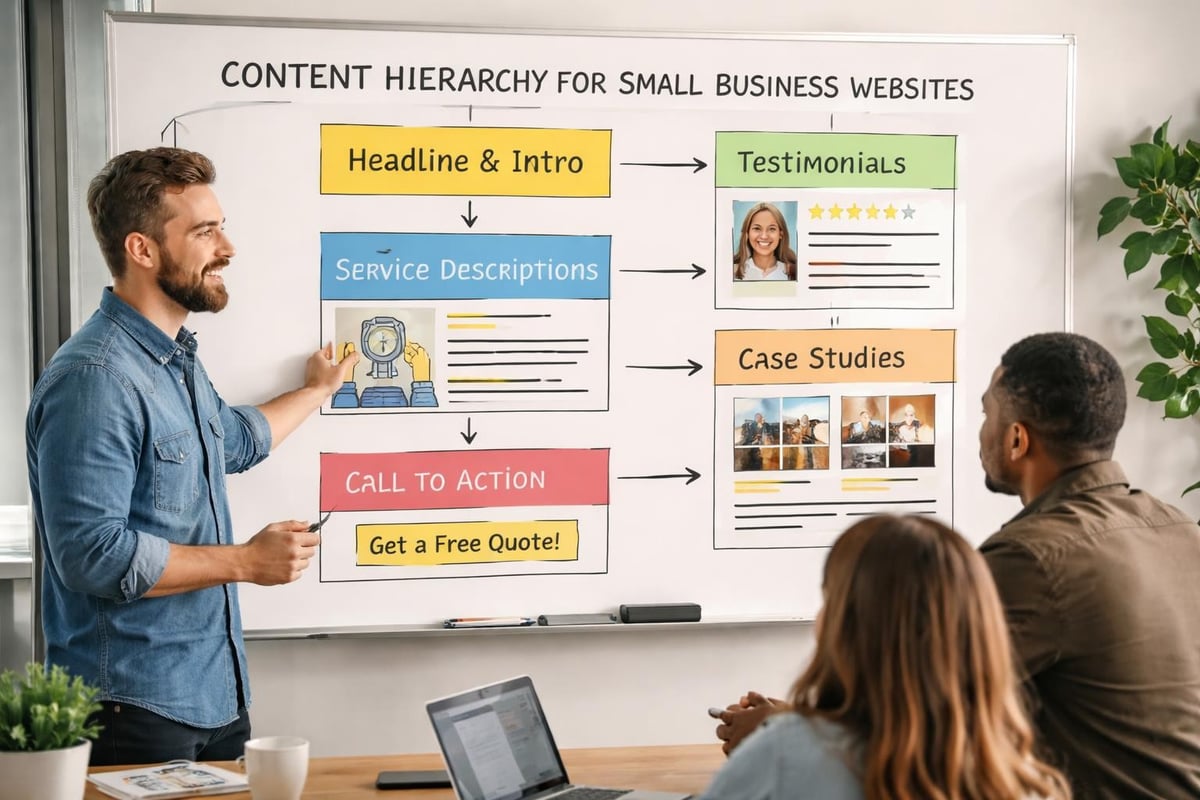
Testimonials and social proof build credibility, particularly for businesses without extensive brand recognition. Video testimonials carry more weight than text quotes, while specific results outperform generic praise. Rather than "Great service!" testimonials should detail problems, solutions, and measurable outcomes.
Calls to Action That Convert
Every page on small businesses websites should guide visitors toward specific actions aligned with business objectives. Vague buttons labeled "Learn More" underperform compared to specific, action-oriented alternatives like "Schedule Your Free Consultation" or "Get Your Custom Quote."
Button placement follows natural reading patterns, typically appearing after compelling content that builds interest. Multiple calls to action at different scroll depths accommodate varying decision speeds, with primary actions repeated strategically throughout longer pages.
Color psychology influences click behavior, though optimal choices depend on overall design context. The most effective call-to-action buttons contrast sharply with surrounding elements while maintaining brand consistency. Testing different approaches through A/B experimentation reveals what resonates with your specific audience.
SEO Optimization for Local Visibility
Local search optimization presents significant opportunities for small businesses websites, particularly those serving geographically defined markets. Google prioritizes local results for queries with location intent, displaying map packs and nearby businesses before organic listings.
Business Victoria’s essential tips for small business websites emphasize creating consistent NAP (Name, Address, Phone) information across all online platforms, including your website, Google Business Profile, and directory listings. Inconsistencies confuse search engines and erode ranking potential.
Location-specific content pages target neighborhoods, suburbs, or service areas you serve. A Leicester-based agency might create dedicated pages for Market Harborough, Loughborough, or other nearby communities, each addressing local customer needs and incorporating relevant geographic keywords naturally.
- Optimize Google Business Profile with complete information, regular posts, and review responses
- Build local citations in relevant directories and industry-specific platforms
- Create location-specific service pages targeting geographic keywords
- Earn reviews from satisfied customers across multiple platforms
- Develop locally-relevant content addressing community needs and interests
Technical SEO Foundations
Meta titles and descriptions function as your search result advertisement, determining whether users click through to your site. Titles should incorporate primary keywords while remaining compelling and under 60 characters. Descriptions expand on the value proposition within 150-160 characters.
Header tag hierarchy (H1, H2, H3) structures content for both readers and search engines. Each page should contain exactly one H1 tag stating the primary topic, with H2 and H3 tags organizing subtopics logically. Crowdspring’s web design best practices reinforce how proper heading structure improves both SEO performance and user experience.
Modern Trends Shaping Small Business Websites in 2026
Artificial intelligence integration has evolved from experimental to essential, with chatbots handling initial customer inquiries, providing instant responses, and qualifying leads before human intervention. Advanced implementations personalize content based on visitor behavior, location, or referral source.
Web design trends for small businesses in 2026 highlight accessibility improvements driven by both legal requirements and inclusive design principles. Websites must accommodate users with visual, auditory, motor, or cognitive disabilities through proper contrast ratios, keyboard navigation, screen reader compatibility, and clear language.

Video content dominates engagement metrics, with background videos creating immediate visual impact and explainer videos communicating complex concepts efficiently. Short-form content performs best, with 60-90 second videos maintaining attention while delivering key messages.
Sustainability and Performance Balance
Environmental consciousness extends to digital presence, with carbon-aware hosting and efficient coding practices reducing website environmental impact. Small businesses websites can implement:
- Optimized image compression reducing bandwidth consumption
- Lazy loading techniques preventing unnecessary data transfer
- Green hosting providers using renewable energy
- Efficient code minimizing processing requirements
These practices simultaneously improve performance, reduce costs, and align with growing consumer expectations around corporate environmental responsibility.
Platform Selection and Development Approaches
Choosing between website builders and custom development depends on business complexity, budget constraints, and long-term scalability requirements. TechRadar’s review of small business website builders evaluates options across multiple dimensions including ease of use, feature breadth, and value proposition.
| Platform Type | Best For | Limitations | Typical Investment |
|---|---|---|---|
| DIY Builders | Simple sites, tight budgets | Design constraints, scalability | £10-50/month |
| Template Platforms | Quick launches, standard needs | Customization limits | £200-1000 initial |
| Custom Development | Unique requirements, growth plans | Higher initial cost | £2000-10000+ |
| Hybrid Solutions | Balance of flexibility and speed | May require developer support | £500-3000 |
Website builders like Wix, Squarespace, and Shopify offer accessible entry points for businesses prioritizing speed and simplicity over customization. These platforms handle technical maintenance, security updates, and hosting infrastructure, reducing ongoing management burden.
Custom development provides maximum flexibility, creating precisely tailored solutions that scale with business growth. This approach makes sense for businesses with unique workflows, specific integration requirements, or distinctive brand identities requiring custom design elements beyond template capabilities.
Integration and Functionality Expansion
Modern small businesses websites rarely function in isolation, connecting with various business systems and marketing platforms. Essential integrations include:
- Email marketing platforms for newsletter campaigns and automated sequences
- CRM systems tracking customer interactions and sales pipelines
- Booking systems managing appointments without phone coordination
- Payment processors facilitating secure online transactions
- Analytics platforms measuring performance and user behavior
API connections enable data flow between systems, eliminating manual data entry and ensuring consistent information across platforms. A booking system integrated with your calendar prevents double-scheduling, while CRM integration ensures inquiry forms populate customer records automatically.
Maintenance and Continuous Improvement
Launching small businesses websites marks the beginning rather than the conclusion of your online presence journey. Regular updates maintain security, improve performance, and keep content fresh and relevant. Software updates, plugin patches, and security monitoring protect against vulnerabilities that cybercriminals actively exploit.
Content updates signal active business operations while providing SEO benefits. Adding blog posts, updating service descriptions, or refreshing imagery demonstrates business vitality. Search engines favor frequently updated sites, interpreting fresh content as relevance signals.
Analytics review identifies improvement opportunities through actual user behavior data. Examining pages with high bounce rates reveals content or design issues requiring attention. Conversion funnel analysis pinpoints where potential customers abandon processes, whether contact forms, checkout sequences, or inquiry pathways.
Heat mapping tools visualize where users click, how far they scroll, and which elements attract attention. This data informs design refinements, content reorganization, and call-to-action optimization based on actual behavior rather than assumptions.
Performance Monitoring and Optimization
Establishing baseline metrics enables progress measurement across key performance indicators:
- Traffic volume tracking visitor growth over time
- Traffic sources identifying effective marketing channels
- Bounce rate measuring immediate engagement
- Session duration indicating content relevance
- Conversion rate quantifying business objective achievement
Monthly performance reviews identify trends, celebrate successes, and spotlight underperforming areas requiring intervention. Seasonal businesses should compare year-over-year rather than month-over-month metrics, accounting for natural fluctuations in demand.
Security and Trust Building
Security breaches damage reputation, customer trust, and search engine rankings. Small businesses websites require multiple security layers protecting both business data and customer information. SSL certificates encrypt data transmission, preventing interception of sensitive information like contact details or payment credentials.
Regular backups create recovery points if technical failures, hacking attempts, or accidental deletions compromise site functionality. Automated daily backups with off-site storage ensure business continuity regardless of hosting problems.
Trust signals throughout your website reassure visitors of legitimacy and professionalism:
- Professional email addresses (you@yourbusiness.com not freemail providers)
- Privacy policy and terms of service documents
- Security badges from recognized providers
- Professional photography rather than stock images
- Detailed about pages with team information
- Physical address and local phone numbers
Industry certifications, professional memberships, and awards deserve prominent display, particularly for competitive sectors where differentiation proves challenging. These credentials provide third-party validation that marketing claims cannot achieve independently.
Building effective small businesses websites requires balancing design aesthetics, technical performance, strategic content, and ongoing optimization in ways that align with specific business objectives and customer needs. Whether you're establishing your first online presence or refreshing an outdated site, these principles provide a framework for creating websites that attract visitors, build trust, and convert interest into tangible business results. At Ruff Idea, we partner with Leicestershire businesses to craft bespoke, visually striking websites that combine expert design with SEO optimization, social media integration, and ongoing support, ensuring your online presence performs as strongly as it looks. Ready to transform your digital presence? Let's create something exceptional together.