The world of search has changed dramatically, as AI-driven algorithms now set the standard for how websites are ranked in 2025. If you want to stay ahead, understanding how to rank on AI is no longer optional—it is essential.
This guide will break down the complexities of AI-powered search engines, showing you clear, actionable strategies to future-proof your visibility. We will explore the evolution of AI in search, reveal the critical ranking factors for 2025, and walk you through practical steps for optimisation.
You will also discover advanced content tactics, technical SEO essentials, and ways to keep your site prepared for whatever comes next. Ready to master how to rank on AI? Let us begin your journey to top rankings.
The Evolution of AI in Search Rankings
The landscape of search has been transformed by AI, fundamentally changing how to rank on ai-driven platforms. Major search engines, such as Google and Bing, now rely on sophisticated machine learning models to deliver results that go far beyond simple keyword matching. These AI systems interpret user intent, context, and even the nuances of natural language queries. Updates like Google's BERT, MUM, and SGE have paved the way for generative AI, enabling engines to generate rich, context-aware answers. In fact, over 70% of search queries in 2025 are influenced by AI-driven algorithms, according to Search Engine Journal. This shift means understanding how to rank on ai is essential for any brand aiming for visibility.

How AI Has Changed Search
AI has revolutionised search by moving from traditional keyword-based ranking to a system that understands user intent and context. Search engines now use advanced models to process conversational queries, interpret context, and generate direct answers. Google's BERT and MUM updates, along with the rise of generative AI like SGE and Bing Copilot, have enabled more nuanced comprehension of content. As a result, the strategies for how to rank on ai have shifted towards creating content that matches real-world questions and needs, not just targeting keywords.
Key Differences: AI Rankings vs Traditional SEO
The core difference in how to rank on ai-powered search engines lies in content evaluation. AI algorithms prioritise content quality, semantic relevance, and alignment with user intent. Old tactics such as keyword stuffing or over-optimising meta tags have lost their impact. Instead, semantic search and topic modelling are key drivers. Brands that adapt, such as those shifting to topic clusters and comprehensive guides, are seeing improved results. For example, a leading retailer restructured its content to focus on user intent, resulting in significant ranking gains. The evolution of AI in SEO is well documented in resources like AI’s Impact on SEO in 2025.
New User Behaviours and Search Experiences
How to rank on ai also depends on understanding new user behaviours. Conversational and voice-based queries are now common, as people interact with search engines as they would with another person. Multi-modal search, which blends text, images, and video, is increasingly popular. AI-generated answers and summaries often dominate the SERPs, leading to a surge in "zero-click" searches and featured snippets. Brands must optimise for these new experiences to remain visible.
The Role of AI in Personalisation and Localisation
AI has made personalisation and localisation central to how to rank on ai-powered platforms. Search engines now analyse user data to deliver hyper-personalised results, considering factors like micro-location and real-time context. Local search has evolved, with AI factoring in not just geographic proximity but also user intent and behaviour. According to Moz, there has been a 60% increase in personalised SERP features since 2023, making it vital for brands to tailor content for local and personalised search experiences.
The Future: What’s Next for AI Search?
Looking ahead, the future of how to rank on ai will involve even deeper integration of predictive search and AI-powered agents. Businesses must remain agile, continually adapting to new AI-driven changes in search behaviour and ranking signals. Those who adopt AI-optimised content strategies early are already gaining market share. As AI continues to advance, staying ahead of these trends will be critical for ongoing SEO success.
Understanding AI Ranking Factors in 2025
The landscape of search is unrecognisable from just a few years ago. If you want to master how to rank on ai, understanding the new ranking factors is essential. AI-driven algorithms now assess a broader set of signals, making it crucial to adapt your SEO strategies to stay ahead.

Content Quality and Relevance in the Age of AI
AI has revolutionised how to rank on ai by prioritising content depth, originality, and comprehensive topical coverage. Algorithms are now sophisticated enough to judge not just keywords but the actual value and expertise behind your content.
Google's E-E-A-T principles have evolved, with AI considering experience, expertise, authoritativeness, and trustworthiness at a granular level. Long-form, well-researched guides now outperform thin, repetitive pages. For a deeper dive into how AI-powered content algorithms are transforming rankings, see Google’s content algorithm update insights.
To optimise, focus on delivering detailed, unique insights and up-to-date information that demonstrates real-world expertise. This is now a primary driver for how to rank on ai.
Semantic Search and Contextual Understanding
Semantic search is at the core of how to rank on ai in 2025. AI algorithms connect related concepts, entities, and topics, moving beyond basic keyword matching.
Developing topic clusters and pillar pages allows your site to offer semantic depth, helping search engines understand the broader context of your content. Interlinking related articles not only boosts relevance but also signals subject authority.
A well-structured content hub ensures that both broad and long-tail queries are addressed. This approach is vital for how to rank on ai, as search engines reward sites that cover topics holistically.
User Intent, Engagement, and Behavioural Signals
Modern AI algorithms now analyse how users interact with your site, making user intent and engagement central to how to rank on ai. Metrics like dwell time, bounce rate, and click patterns are all scrutinised.
Content must match the precise intent behind each query, whether informational, navigational, or transactional. Pages that satisfy user needs and encourage further exploration see higher engagement rates.
According to Backlinko, pages optimised for intent enjoy 35% more user engagement. This behavioural feedback loop is a critical signal for how to rank on ai in the current landscape.
Technical SEO for AI: Structured Data and Site Architecture
Technical SEO remains foundational for how to rank on ai. AI search engines depend on structured data, such as schema markup, to accurately interpret and surface your content.
Implementing advanced schema for products, FAQs, and reviews helps your site appear in rich results and AI-powered answer boxes. Site architecture should be clean and intuitive, ensuring crawlability and fast load times.
Mobile-first design and entity recognition further support discoverability. Sites with robust technical SEO consistently achieve greater visibility, proving their importance for how to rank on ai.
Trust, Authority, and Brand Signals
Building trust and authority is more critical than ever for how to rank on ai. AI algorithms evaluate brand mentions, sentiment, and external validation across the web.
Consistent, high-quality content builds topical authority within your niche. Positive brand sentiment and authoritative backlinks signal your reliability to search engines.
According to SEMrush, authoritative brands receive twice as many AI-generated SERP features. This demonstrates the power of trust and authority in how to rank on ai.
The Impact of User-Generated Content and Reviews
User-generated content (UGC) has become a significant ranking factor for how to rank on ai. Reviews, testimonials, and community engagement offer real-world validation that AI algorithms can measure.
Integrating reviews and ratings into your site architecture, and marking them up with schema, increases your chances of ranking for local and commercial queries. Social proof not only boosts trust but also enhances your site's relevance in the eyes of AI.
Local businesses with high review volumes consistently outperform their competitors, making UGC a cornerstone of how to rank on ai.
Step-by-Step Guide: Optimising for AI Rankings
Staying ahead in 2025 means adopting a structured approach to AI-driven SEO. This step-by-step guide breaks down exactly how to rank on ai, from research to analytics, ensuring your site is ready for the next evolution in search.
Step 1: Conduct AI-Focused Keyword and Topic Research
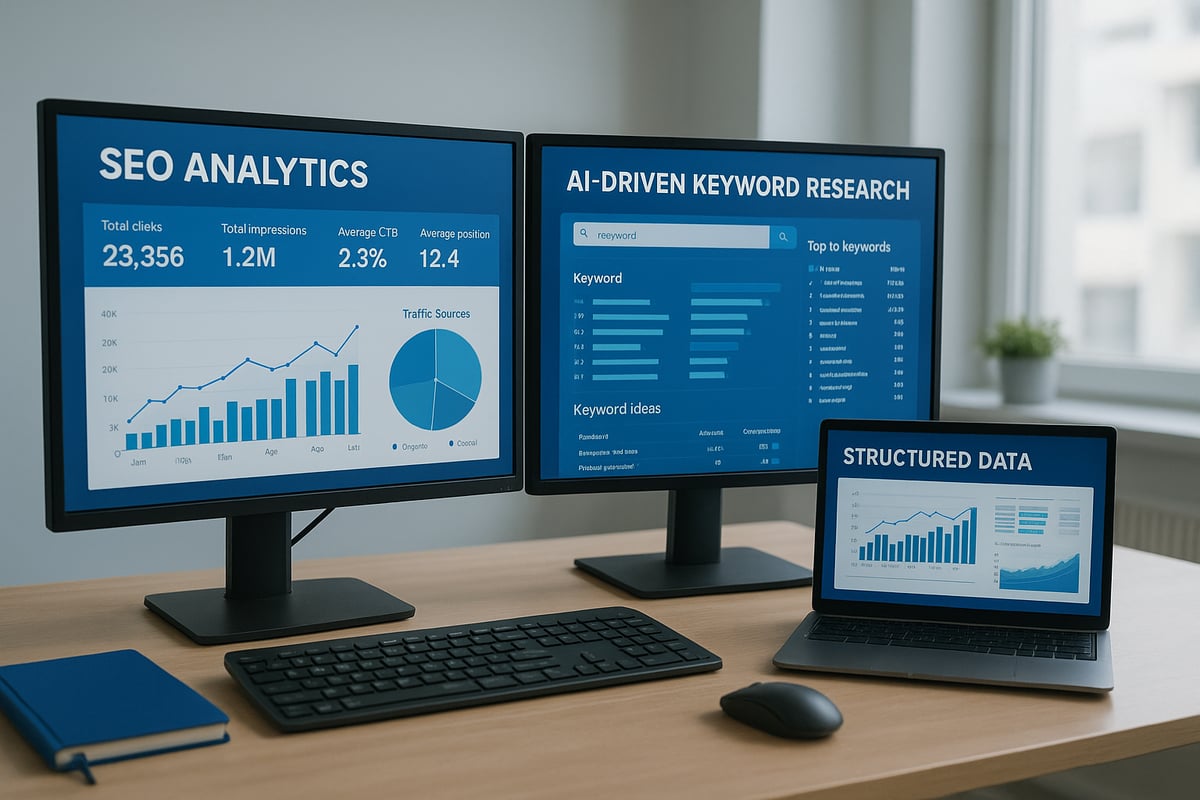
The foundation of how to rank on ai starts with understanding semantic and intent-driven keywords. Traditional keyword tools alone are no longer enough. Now, platforms like MarketMuse and SEMrush Topic Research help reveal topic clusters and content gaps that AI algorithms prioritise.
Identify key stages of the buyer’s journey and map topics to user personas. This approach ensures your content aligns with what AI recognises as relevant and authoritative. For a deeper dive into optimising specifically for AI-driven search engines, explore the Generative Engine Optimisation (GEO) guide.
- Use AI-powered keyword discovery tools.
- Build out topic clusters and supporting articles.
- Map each topic to a specific intent or persona.
Focus on continuous research to keep your strategy aligned with evolving AI search behaviours.
Step 2: Create Comprehensive, Human-Centric Content
To master how to rank on ai, prioritise content that addresses user needs in depth. Write for humans first, ensuring clarity, engagement, and value. AI now favours long-form, multimedia-rich resources that answer multiple related questions in one place.
Incorporate videos, infographics, and images to satisfy multi-modal search. Use clear headings, bullet points, and concise language. Detailed guides with authentic expertise consistently outperform thin, generic posts.
- Address all facets of a topic within one resource.
- Embed relevant media and interactive elements.
- Review and update content regularly for freshness.
Prioritise quality and depth to signal authority to AI algorithms.
Step 3: Implement Advanced On-Page SEO for AI
On-page SEO is evolving, and how to rank on ai depends on precise optimisation. Use structured headings, descriptive meta tags, and advanced schema markup to help AI understand your content’s entities and relationships.
Add FAQ and review schema where appropriate. Highlight key points and use semantic HTML to clarify meaning. Well-optimised pages are more likely to appear in AI-generated answer boxes and rich results.
- Apply schema for FAQs, products, and reviews.
- Optimise titles and meta descriptions for clarity.
- Use internal links to reinforce topic clusters.
Technical accuracy is essential for AI to surface your content in relevant contexts.
Step 4: Enhance User Experience and Engagement
A seamless user experience is a critical factor in how to rank on ai. Fast-loading pages, mobile usability, and intuitive navigation all influence AI’s evaluation of your site. Interactive features like chatbots or calculators can boost engagement and dwell time.
Monitor site speed with tools like PageSpeed Insights. Ensure accessibility for all users and make navigation straightforward. Sites with superior UX consistently see higher AI-driven rankings.
- Prioritise mobile-first design and fast load times.
- Add interactive tools to increase engagement.
- Test accessibility for compliance and inclusivity.
Regularly audit your site to maintain optimal performance and user satisfaction.
Step 5: Build Authority with Quality Backlinks and Brand Mentions
Earning trust signals is fundamental to how to rank on ai. Focus on acquiring backlinks from reputable, relevant sources. Digital PR campaigns, guest posting, and thought leadership can increase your brand’s online visibility.
Encourage organic brand mentions and citations across industry forums, social platforms, and news sites. AI algorithms assess both the quality and context of these signals when ranking content.
- Target authoritative domains for backlinks.
- Promote your content through partnerships and PR.
- Monitor brand mentions and respond to feedback.
Authority and trust are ongoing efforts that strengthen your AI ranking potential.
Step 6: Leverage User-Generated Content and Reviews
User-generated content (UGC) is a powerful way to reinforce how to rank on ai. Encourage reviews, testimonials, and community discussions on your site. AI recognises genuine engagement and rewards businesses with active user feedback.
Integrate reviews into your site architecture and apply appropriate schema markup. Highlight positive feedback and address concerns transparently to build trust.
- Add review sections to key landing pages.
- Feature testimonials and case studies.
- Use schema to help AI interpret user feedback.
UGC not only boosts rankings but also enhances credibility in the eyes of both users and algorithms.
Step 7: Monitor Performance and Adapt with AI Analytics
Continuous improvement is at the heart of how to rank on ai. Leverage AI-powered analytics platforms to monitor ranking factors and user engagement in real time. Analyse dwell time, click patterns, and conversion rates to identify optimisation opportunities.
Set up dashboards for key metrics and schedule regular reviews. Adapt your strategy based on AI-driven insights to maintain or improve your position as algorithms evolve.
- Track rankings, engagement, and technical performance.
- Test changes and measure their impact.
- Iterate quickly in response to new AI trends.
Staying agile ensures your SEO remains effective in an AI-dominated landscape.
Content Strategies for AI Search Dominance
To truly master how to rank on ai in 2025, your content strategy must evolve alongside search technology. AI-powered engines now prioritise context, authority, and relevance over old-fashioned tactics. The following strategies will help you build a future-proof presence and drive consistent visibility as algorithms become more sophisticated.

Building Topical Authority and Content Hubs
Content hubs are essential for how to rank on ai, as they structure your site around key topics rather than isolated keywords. Begin by identifying core themes relevant to your audience, then create in-depth pillar pages supported by interlinked articles. This approach signals expertise and helps AI understand your topical depth.
Consider adopting strategies from Generative Engine Optimisation (GEO) guide, which outlines how topic clusters and semantic relationships boost AI-driven rankings. Organise your hub-and-spoke model so users and algorithms can easily navigate related content. Update hubs regularly to maintain authority and relevance.
Optimising for Conversational and Voice Search
AI now interprets queries in a conversational, natural language format. To optimise for how to rank on ai, write content that answers questions directly, using clear, concise sentences. Target long-tail, question-based keywords that mirror how real people speak.
Include FAQs, dialogue-style headings, and structured responses. This not only increases your chances of appearing in voice search results but also aligns your content with how AI processes intent. As voice queries surge, adapting your tone and format is no longer optional for AI search visibility.
Creating Multi-Modal and Visual Content
AI search engines prefer multi-modal content that caters to diverse user preferences. To stay ahead in how to rank on ai, integrate images, videos, infographics, and interactive elements throughout your pages. Use descriptive alt text and video schema to help AI identify and surface your visual assets.
Consider embedding explainer videos, step-by-step guides, or data visualisations. Multi-modal content not only improves engagement but also satisfies AI’s need for rich, contextual information, increasing your chances of ranking in visual and mixed-result SERPs.
Answering Featured Snippets and AI Summaries
AI-driven search prioritises clear, authoritative answers. Structure your content to target featured snippets by addressing common questions with succinct, direct responses. Use bullet points, numbered lists, or tables to present information.
When planning how to rank on ai, focus on the “People Also Ask” boxes and summarise key points at the start of each section. This increases the likelihood your content will be selected for AI-generated summaries or direct answer boxes, driving more visibility and traffic.
Localising Content for AI-Driven Local Search
Local intent drives a significant share of AI search results. To optimise how to rank on ai for local queries, tailor your content with geo-specific keywords, incorporate local schema, and maintain an up-to-date Google Business Profile.
Encourage reviews and testimonials from local customers, as AI values real user feedback. Highlight local events, services, or news to enhance contextual relevance. By addressing micro-local needs, you position your site for superior performance in AI-powered local search.
Technical SEO Essentials for AI Ranking
Staying visible in AI-powered search means mastering the technical foundations of your site. If you want to know how to rank on ai, you must go beyond traditional SEO and address the specific signals that AI algorithms use to assess, index, and present your content.
Advanced Structured Data and Schema Markup
One of the core elements of how to rank on ai is providing structured data that AI can easily understand. Implementing schema markup for products, FAQs, reviews, and events allows search engines to extract key information and present it in rich results.
For example, adding an FAQ schema can help your content appear in AI-generated answer boxes. Use types such as Product, Review, and Event to signal relevance and context.
| Schema Type | Purpose | AI Benefit |
|---|---|---|
| FAQ | Direct answers | Featured snippets |
| Product | E-commerce data | Rich product cards |
| Review | Trust signals | Star ratings |
| Event | Event details | Calendar results |
Always validate your structured data using Google's Rich Results Test. The more context you provide, the better your chances of improving how to rank on ai.
Site Speed, Core Web Vitals, and Mobile Optimisation
AI algorithms prioritise fast, seamless experiences. To master how to rank on ai, your site must meet Core Web Vitals benchmarks: Largest Contentful Paint (LCP), First Input Delay (FID), and Cumulative Layout Shift (CLS).
A slow-loading site frustrates users and signals poor quality to AI. Over 53% of mobile users abandon sites that take more than three seconds to load. Responsive design, image optimisation, and efficient code are essential.
For a detailed guide on improving technical SEO, see these technical SEO and site speed tips. Ensuring top performance directly impacts how to rank on ai across all devices.
Crawlability, Indexation, and Site Architecture
If AI cannot crawl or index your pages efficiently, your chances of learning how to rank on ai diminish. Maintain a clear, logical site structure with internal links connecting related content.
Key actions include:
- Creating and submitting XML sitemaps.
- Using
robots.txtto guide search bots. - Avoiding duplicate content issues.
- Keeping navigation simple and intuitive.
Example robots.txt snippet:
User-agent: *
Disallow:
Sitemap: https://example.com/sitemap.xml
A well-structured site ensures AI algorithms can easily access and interpret your content, increasing your visibility and helping you understand how to rank on ai.
Security, Accessibility, and Trust Signals
Security and accessibility are now non-negotiable for how to rank on ai. Use HTTPS to protect user data and meet AI's preference for secure sites. Enhance accessibility by following WCAG guidelines, providing alt text for images, and ensuring keyboard navigation.
Trust signals matter. Display visible indicators such as SSL certificates, privacy policies, and customer reviews. AI uses these cues to assess reliability and authority.
Checklist for trust and accessibility:
- HTTPS enabled sitewide
- Clear privacy policy
- Accessible menus and forms
- Consistent branding and contact info
By prioritising security and accessibility, you build credibility and strengthen your ability for how to rank on ai in 2025 and beyond.
Future-Proofing Your SEO for AI Advancements
Navigating the evolving landscape of AI-driven search requires more than just traditional optimisation. Businesses that understand how to rank on ai will stay ahead of competitors and maintain visibility as algorithms advance. By anticipating changes and adopting forward-thinking practices, you can secure your site’s future in the search ecosystem.
Staying Ahead of AI Algorithm Updates
AI algorithms are evolving rapidly, often introducing unexpected ranking shifts. To master how to rank on ai, monitor search engine announcements, patent filings, and industry news regularly. Early awareness of updates allows you to adjust strategies before your competitors.
Consider subscribing to platforms that provide insights into upcoming changes. Analysing competitors who swiftly adapt to new AI-driven features can reveal best practices. For a broader perspective on what’s coming next, explore the Future of AI in SEO and Content Marketing to identify trends that could shape your roadmap.
Integrating AI Tools and Automation in SEO
Adopting AI-powered tools is no longer optional for those serious about how to rank on ai. These platforms can automate keyword research, content optimisation, and performance monitoring, freeing up valuable time for strategic work.
Popular AI tools help uncover hidden opportunities and automate repetitive tasks, such as technical audits or link analysis. Leveraging these systems ensures your SEO efforts remain scalable and data-driven. Staying current with 2024 SEO trends and strategies can help you choose the right automation solutions for your business.
Building an Agile, Experiment-Driven SEO Culture
Flexibility is vital when learning how to rank on ai. Foster a culture where experimentation and rapid iteration are encouraged. Cross-functional collaboration between content creators, developers, and marketers accelerates problem-solving and innovation.
Implement regular testing cycles to measure the impact of new tactics or tools. Document findings and share them across teams to build a knowledge base. Companies that continuously adapt and learn are best positioned to thrive as AI search evolves.
You’ve now got a clear roadmap for mastering AI-driven search in 2025—from understanding new ranking factors to building authority and future-proofing your website. If you’re ready to put these strategies into action but want a partner who truly understands both AI SEO and standout web design, we’re here to help. At Ruff Idea, we specialise in creating bespoke, high-performing websites that look great and get noticed by AI-powered search engines. Let’s work together to give your business the edge it deserves—Get in touch and start your journey towards smarter, more effective search rankings.